The traditional campaign trail has become one of the political casualties of the COVID-19 epidemic. Joe Biden ceased holding large public events after he became the de facto Democratic nominee the week after Super Tuesday, just as the virus began its nationwide spread, and the Trump campaign has retreated to a similar policy after its comeback rally in Tulsa last month proved to be an over-hyped and under-attended disappointment. Even the president's most dedicated supporters turned out to be less enthusiastic about in-person electioneering in the midst of an uncontrolled national outbreak of disease.
It's become obvious this year how much of the standard press coverage of presidential campaigns is structured around the idea of a daily "top story" generated by the assignment of reporters and camera crews to follow the candidates around the country, ready to leap on anything that appears novel or unscripted amidst the otherwise repetitive cycle of stump speeches, rope lines, factory visits, and diner drop-ins. Most personal accounts of presidential elections written by candidates or journalists are blurry, weary travelogues that grudgingly acknowledge the democratic virtue of in-person politicking before returning to complaints about endless drudgery, exhaustion, and logistical snags.
But take away all that hopscotching from one battleground state to the next, and it's easy to wonder whether there really is a campaign at all. Joe Biden is continuing to hold virtual events and deliver policy speeches, but they simply don't seem as important—and certainly don't receive as much coverage—without big, cheering crowds and a chartered jet to schlep around the entourage. And Donald Trump's inability to hold his signature raucous rallies has helped to erase the line between presidential campaigning and presidential governing, as his COVID briefings and other White House events have come to serve as substitutes. Even if the virtual programs for the national conventions end up being snazzy productions, they will likely receive less attention than usual this year merely because they won't seem as momentous to the press or public as the in-person events of years past.
Might the lack of a traditional campaign trail affect the outcome of the election? Republicans are starting to worry that the result in November will wind up being a simple popular referendum on an increasingly unpopular admininistration—and not just in the presidential vote, but in congressional and down-ballot races as well. The Washington Post recently reported that many electorally vulnerable Republican Senate incumbents are challenging their opponents to an extensive series of debates with the hope that less-tested candidates will have a greater chance of screwing up in public, since the reduction of normal campaign events has also curtailed the usual practice of shadowing the opposing candidate with a "tracker" armed with a video camera to capture footage of any mistake. Meanwhile, Democrats have become concerned that their efforts to register new voters and mobilize sporadic participants will suffer from the relative lack of traditional grassroots activity this year.
Of course, the election was likely to serve as a referendum on Trump even before the onset of COVID, and the primary campaign arsenal of congressional candidates—paid advertising—remains unaffected by the current crisis. Interested would-be voters who have postponed registration so far may start to register in greater numbers as the election starts to approach, and the atmosphere of national crisis could also boost participation independent of organized get-out-the-vote initiatives. So the reduction of in-person campaigning this year may well have little effect on the outcome of the 2020 elections.
But the lack of so many familiar trappings of American political culture, from hand-shaking and small talk at midwestern state fairs and ice cream shops to the quadrennial spectacles of the national conventions, is still something worth mourning in our moment of disruption and isolation. Sure, a lot of this activity was formally obsolete and (for candidates, staff, and journalists) sometimes annoyingly inconvenient. But why should political campaigns necessarily be conducted for the maximum comfort or entertainment of their professional participants? Like so many other social rituals, these practices have taken on a meaning of their own as symbols of participatory democracy, and their absence—hopefully a temporary one—should rightfully be lamented as a small part of all that has been lost in this very sad year.
Thursday, July 30, 2020
Monday, July 20, 2020
The South Is Still Very Republican—But Southern Democrats Aren't "Southern Democrats" Anymore
In an era of historically stable electoral maps, any hint of novelty is likely to attract a much greater degree of attention than its true importance would warrant. And so recent signs of an electoral trend favoring Democratic candidates in certain corners of the South have been repeatedly touted as earth-shaking developments; Friday's Wall Street Journal even refers to a potential "realignment" in the region. If the news media's prototypical voter of interest after the 2016 election was the (pro-Trump) working-class white resident of a small midwestern town, in 2020 the new objects of fascination are the (anti-Trump) well-educated professionals and voters of color populating the suburbs of large southern cities like Atlanta, Charlotte, and Houston.
But the South as a whole is still very Republican—in fact, it remains the main source of popular support for the national Republican Party. Among the 14 southern states (defined here as the 11 members of the former Confederacy plus West Virginia, Kentucky, and Oklahoma), Democrats have built an overall advantage in just one (Virginia), and in only Florida and North Carolina are the two parties closely matched at the state level. Across the rest of the region, Republicans control all 22 state legislative chambers, 9 of 11 governorships (having lost only Kentucky and Louisiana by narrow margins in off-year elections to replace unpopular Republican incumbents), 20 of 22 U.S. Senate seats (all but those held by Joe Manchin of West Virginia and Doug Jones of Alabama, the last an accidental special election winner who is unlikely to retain his seat this fall), nearly every other statewide office, and 74 of 101 U.S. House seats.
The Democratic Party hit a historic low point in the South during the 2014–2016 period and has made a bit of a comeback since then, as it has elsewhere in the country. But this partisan rebound has so far been mostly restricted to a few major metropolitan areas, flipping some congressional and state legislative seats to Democratic challengers without yet dismantling the power of a formerly dominant state Republican Party. Yes, Beto O'Rourke in Texas and Stacey Abrams in Georgia represented tantalizing near-miss candidacies for Democrats in 2018, though both also benefited from flawed opponents and unusually favorable national partisan conditions—the same electoral assets that have so far kept Joe Biden within reach of carrying both states this year. But if national polls start to tighten before November, the Biden campaign will probably retreat to defend pivotal states elsewhere, abandoning the ambitious but unnecessary goal of making additional inroads in the South.
In general, the change so far in the southern Democratic Party's electoral strength has received too much attention and the change in its internal complexion has received too little. Old-style southern Democrats—the kind with rural constituencies, good-ol'-boy personas, and philosophical discomfort with the northern wing of the party on issues from abortion and gun control to environmental regulation and energy policy—are nearly extinct in elective office; Manchin, Louisiana governor John Bel Edwards, and one or two House members are just about the last of this breed above the local level. The newer generations of southern Democratic politicians are much more likely to be drawl-less metropolitans, often first- or second-generation transplants from outside the region. Many of them are members of racial minority groups, even in majority-white constituencies. And they are mostly not ideological misfits within the national Democratic Party, instead sitting squarely inside the prevailing Obama-Biden pragmatic liberal mainstream on economic and social issues alike.
When Democrats gained a majority in both houses of the Virginia legislature last November, achieving unified control of state government for the first time in decades, they immediately demonstrated how much the state party had evolved since the days when it was led by conservative-leaning figures like Harry Byrd and Howard "Judge" Smith. The burst of legislative activity that ensued not only raised the state minimum wage and imposed regulations on energy producers; it also loosened restrictions on abortion, banned discrimination on the basis of sexual orientation, closed the "gun show loophole" by requiring background checks for all firearm purchases, decriminalized marijuana possession, and allowed local governments to remove Confederate monuments. This is the contemporary policy agenda of regular national Democrats, making few concessions to the distinctive cultural commitments of traditional southern politics, and any future Democratic majority in North Carolina, Florida, Texas, or Georgia is more likely to follow Virginia's lead than to attempt to revive the old style of governing.
Even if they benefit from another "blue wave" this year, Democrats are still a long way away from true competitiveness in most of the South. But the evolution of its main sources of electoral support in the region is important for the behavior of the party at the national level. Democrats elected from southern congressional seats are less likely to be as serious an impediment to the legislative agenda of the next Democratic president as they were to that of Obama or Bill Clinton, in part because the constituencies that they represent are less self-consciously "southern," less alienated from national left-of-center politics, and moving toward, rather than away from, the Democratic Party over time. Republicans are still very much the party of the South, but Democrats are hoping to eventually become the party of the New South.
But the South as a whole is still very Republican—in fact, it remains the main source of popular support for the national Republican Party. Among the 14 southern states (defined here as the 11 members of the former Confederacy plus West Virginia, Kentucky, and Oklahoma), Democrats have built an overall advantage in just one (Virginia), and in only Florida and North Carolina are the two parties closely matched at the state level. Across the rest of the region, Republicans control all 22 state legislative chambers, 9 of 11 governorships (having lost only Kentucky and Louisiana by narrow margins in off-year elections to replace unpopular Republican incumbents), 20 of 22 U.S. Senate seats (all but those held by Joe Manchin of West Virginia and Doug Jones of Alabama, the last an accidental special election winner who is unlikely to retain his seat this fall), nearly every other statewide office, and 74 of 101 U.S. House seats.
The Democratic Party hit a historic low point in the South during the 2014–2016 period and has made a bit of a comeback since then, as it has elsewhere in the country. But this partisan rebound has so far been mostly restricted to a few major metropolitan areas, flipping some congressional and state legislative seats to Democratic challengers without yet dismantling the power of a formerly dominant state Republican Party. Yes, Beto O'Rourke in Texas and Stacey Abrams in Georgia represented tantalizing near-miss candidacies for Democrats in 2018, though both also benefited from flawed opponents and unusually favorable national partisan conditions—the same electoral assets that have so far kept Joe Biden within reach of carrying both states this year. But if national polls start to tighten before November, the Biden campaign will probably retreat to defend pivotal states elsewhere, abandoning the ambitious but unnecessary goal of making additional inroads in the South.
In general, the change so far in the southern Democratic Party's electoral strength has received too much attention and the change in its internal complexion has received too little. Old-style southern Democrats—the kind with rural constituencies, good-ol'-boy personas, and philosophical discomfort with the northern wing of the party on issues from abortion and gun control to environmental regulation and energy policy—are nearly extinct in elective office; Manchin, Louisiana governor John Bel Edwards, and one or two House members are just about the last of this breed above the local level. The newer generations of southern Democratic politicians are much more likely to be drawl-less metropolitans, often first- or second-generation transplants from outside the region. Many of them are members of racial minority groups, even in majority-white constituencies. And they are mostly not ideological misfits within the national Democratic Party, instead sitting squarely inside the prevailing Obama-Biden pragmatic liberal mainstream on economic and social issues alike.
When Democrats gained a majority in both houses of the Virginia legislature last November, achieving unified control of state government for the first time in decades, they immediately demonstrated how much the state party had evolved since the days when it was led by conservative-leaning figures like Harry Byrd and Howard "Judge" Smith. The burst of legislative activity that ensued not only raised the state minimum wage and imposed regulations on energy producers; it also loosened restrictions on abortion, banned discrimination on the basis of sexual orientation, closed the "gun show loophole" by requiring background checks for all firearm purchases, decriminalized marijuana possession, and allowed local governments to remove Confederate monuments. This is the contemporary policy agenda of regular national Democrats, making few concessions to the distinctive cultural commitments of traditional southern politics, and any future Democratic majority in North Carolina, Florida, Texas, or Georgia is more likely to follow Virginia's lead than to attempt to revive the old style of governing.
Even if they benefit from another "blue wave" this year, Democrats are still a long way away from true competitiveness in most of the South. But the evolution of its main sources of electoral support in the region is important for the behavior of the party at the national level. Democrats elected from southern congressional seats are less likely to be as serious an impediment to the legislative agenda of the next Democratic president as they were to that of Obama or Bill Clinton, in part because the constituencies that they represent are less self-consciously "southern," less alienated from national left-of-center politics, and moving toward, rather than away from, the Democratic Party over time. Republicans are still very much the party of the South, but Democrats are hoping to eventually become the party of the New South.
Monday, July 06, 2020
Were Democratic Voters Right About Biden's Electability?
The idea that there is often a difference between the candidate you love the most and the candidate who has the best chance to win is a long-standing fixture of nomination politics, especially in the Democratic Party. But the assumption that "electability" is a quality shared by some potential nominees more than others, and even that it is a valid criterion of candidate selection, was disputed more than usual in the 2020 Democratic presidential primaries. Though it requires diving back into what now seems like a long-ago pre-COVID political world, it's worth revisiting this debate from the perspective of the summer campaign and the current state of the general election race.
Electability was a fraught subject in the 2020 Democratic nomination contest partially because of the perception of a significant ideological divide within the party, made more salient by the viable candidacy of self-described socialist Bernie Sanders. Sanders's lack of defensiveness about his philosophical commitments made him an admirable figure in the eyes of his supporters, but also provoked considerable opposition to his prospective nomination among other Democrats—including most of the party's elected officials and a large proportion of its activists and organizational leadership.
Layered on top of this familiar debate over whether a tradeoff exists between electability and ideological purity was another set of concerns about candidates' social identities. Many Democrats had deduced from the racist backlash after Barack Obama's 2008 election and the unexpected defeat of Hillary Clinton in 2016 that non-white and (especially) female presidential candidates are likely to lose votes due to the persistence of popular prejudices. Even though they supported the general goal of increasing the demographic diversity of the nation's officeholding class, a number of Democratic primary voters proceeded to draw the natural conclusion that nominating a white male presidential candidate for the first time since 2004 would be the safest path to ejecting the hated Trump from office.
But the prevalence of this view dismayed some feminist commentators, who continued to ascribe Trump's political rise to the prevalence of misogyny in the American public but who objected when this argument was then cited as justification for supporting a male nominee to oppose him. In the young progressive circles that are disproportionately well-represented in the online world, it was common either to reject the electability logic altogether or to claim that it actually favored candidates on the left. The science reporter at a well-known "explainer" website even argued that because differences in the relative potential strength of prospective nominees cannot be determined precisely in advance, the entire concept was dubious even in the abstract: "it's subjective, not objective . . . electability ain't no science." (Normally, the scientific mode of inquiry tends to make a stronger distinction between the difficulty of measuring a phenomenon and the existence or absence of the phenomenon itself.)
Despite these assertions, a coalition of the Democratic Party's most pragmatic constituencies—including African-Americans, southerners, upscale suburbanites, and senior citizens—ultimately rallied behind Joe Biden's self-presentation as the safest choice to send into battle against Trump. Now that we're about midway between the point in March at which Biden became the presumptive Democratic nominee and the date of the November election, it's time to re-evaluate the electability debate in light of how the campaign has proceeded so far.
From one perspective, the electability argument for Biden has been completely vindicated. Biden has opened up a bigger lead over Trump in the national popular vote than any candidate has enjoyed at this stage since Bill Clinton coasted to re-election in 1996, and he is so well-positioned in the electoral college that the battleground map has expanded into the traditional red territory of Arizona, Georgia, and even Texas. The Trump campaign has proven unable as of yet to land a damaging punch on Biden, and has even struggled to find a promising line of attack.
Biden hasn't been as invisible a candidate as some critics claim, but his campaign activities during the pandemic have not generated much sustained attention. Because journalists do not find the very familiar Biden to be a particularly fruitful source of interesting stories, the national media has been focusing instead almost entirely on Trump, and Trump's spiraling political problems, since the Democratic nomination wrapped up after Super Tuesday. The relative novelty of nearly every other major potential nominee—Sanders, Elizabeth Warren, Pete Buttigieg—would have attracted more coverage from the media and pulled the spotlight away from Trump much more frequently.
On the other hand, Biden's current success surely reflects the sinking fortunes of Trump's presidency more than any particular attribute or skill of his own. Even more than most, this election promises to serve as a referendum on the performance of the incumbent; perhaps any plausible Democratic nominee would have opened up a steady lead after the events of the past few months. As Trump's approval ratings continue to slide, supporters of Democratic candidates who were deemed less electable in the primaries might justifiably feel in retrospect that 2020 may well turn out to be a missed opportunity. Perhaps the party could have taken the additional risk associated with a non-white-male or more left-wing nominee while still retaining a good chance of victory.
Because we lack access to the parallel universes in which other nominees were chosen, it's impossible to completely settle the electability debate. However, enough evidence now exists to shed light on two claims made by some advocates of non-Biden candidates in the 2020 Democratic primaries. One is that there are so few remaining swing voters in our current age of rampant polarization that mobilization of the party base is more productive than trying to achieve a broader appeal, and the other is that a Biden nomination would not excite enough voters on the left to stimulate this necessary mobilization.
Both of these claims have already been contradicted by the polls. Biden wouldn't have pulled into the strong lead he now holds if he weren't drawing significant support from previous Republican voters. (According to recent surveys by the New York Times, 14 percent of battleground state residents who supported Trump in 2016 are not supporting him in 2020.) After years of media stories about Trump’s skill in stoking the passionate devotion of his own party, the last few months have forced a widespread journalistic rediscovery of the importance of swing voters and the danger of Trump's declining popularity among this still-pivotal bloc. And while Biden himself doesn't inspire as much personal enthusiasm among Democrats as Trump does among many Republicans, overall levels of interest in the election are equal across party lines: Democratic voters are as motivated to vote against the president as Republicans are to vote for him.
There are still four months to go in the campaign, which is still plenty of time for the prevailing dynamic to change. Republicans have become concerned that Biden's status as a elderly white man who isn't a socialist means that the familiar playbook of accusing Democrats of supporting left-wing extremism or revolutionary social change won't work as well against him as it would have against other potential nominees. But Biden's to-be-announced running mate will be a woman, probably a woman of color, and quite possibly a woman of color with a more liberal record than his. It's likely that she will wind up serving as the target of these attacks, with Biden himself portrayed by the Trump campaign as too hapless and mentally impaired to prevent her from imposing her "radical" agenda on the nation if elected. Just because Biden won the Democratic nomination by promising to transcend divisions of race, gender, and ideology doesn't mean that the fall campaign won't once again be dominated by these highly-charged subjects.
Electability was a fraught subject in the 2020 Democratic nomination contest partially because of the perception of a significant ideological divide within the party, made more salient by the viable candidacy of self-described socialist Bernie Sanders. Sanders's lack of defensiveness about his philosophical commitments made him an admirable figure in the eyes of his supporters, but also provoked considerable opposition to his prospective nomination among other Democrats—including most of the party's elected officials and a large proportion of its activists and organizational leadership.
Layered on top of this familiar debate over whether a tradeoff exists between electability and ideological purity was another set of concerns about candidates' social identities. Many Democrats had deduced from the racist backlash after Barack Obama's 2008 election and the unexpected defeat of Hillary Clinton in 2016 that non-white and (especially) female presidential candidates are likely to lose votes due to the persistence of popular prejudices. Even though they supported the general goal of increasing the demographic diversity of the nation's officeholding class, a number of Democratic primary voters proceeded to draw the natural conclusion that nominating a white male presidential candidate for the first time since 2004 would be the safest path to ejecting the hated Trump from office.
But the prevalence of this view dismayed some feminist commentators, who continued to ascribe Trump's political rise to the prevalence of misogyny in the American public but who objected when this argument was then cited as justification for supporting a male nominee to oppose him. In the young progressive circles that are disproportionately well-represented in the online world, it was common either to reject the electability logic altogether or to claim that it actually favored candidates on the left. The science reporter at a well-known "explainer" website even argued that because differences in the relative potential strength of prospective nominees cannot be determined precisely in advance, the entire concept was dubious even in the abstract: "it's subjective, not objective . . . electability ain't no science." (Normally, the scientific mode of inquiry tends to make a stronger distinction between the difficulty of measuring a phenomenon and the existence or absence of the phenomenon itself.)
Despite these assertions, a coalition of the Democratic Party's most pragmatic constituencies—including African-Americans, southerners, upscale suburbanites, and senior citizens—ultimately rallied behind Joe Biden's self-presentation as the safest choice to send into battle against Trump. Now that we're about midway between the point in March at which Biden became the presumptive Democratic nominee and the date of the November election, it's time to re-evaluate the electability debate in light of how the campaign has proceeded so far.
From one perspective, the electability argument for Biden has been completely vindicated. Biden has opened up a bigger lead over Trump in the national popular vote than any candidate has enjoyed at this stage since Bill Clinton coasted to re-election in 1996, and he is so well-positioned in the electoral college that the battleground map has expanded into the traditional red territory of Arizona, Georgia, and even Texas. The Trump campaign has proven unable as of yet to land a damaging punch on Biden, and has even struggled to find a promising line of attack.
Biden hasn't been as invisible a candidate as some critics claim, but his campaign activities during the pandemic have not generated much sustained attention. Because journalists do not find the very familiar Biden to be a particularly fruitful source of interesting stories, the national media has been focusing instead almost entirely on Trump, and Trump's spiraling political problems, since the Democratic nomination wrapped up after Super Tuesday. The relative novelty of nearly every other major potential nominee—Sanders, Elizabeth Warren, Pete Buttigieg—would have attracted more coverage from the media and pulled the spotlight away from Trump much more frequently.
On the other hand, Biden's current success surely reflects the sinking fortunes of Trump's presidency more than any particular attribute or skill of his own. Even more than most, this election promises to serve as a referendum on the performance of the incumbent; perhaps any plausible Democratic nominee would have opened up a steady lead after the events of the past few months. As Trump's approval ratings continue to slide, supporters of Democratic candidates who were deemed less electable in the primaries might justifiably feel in retrospect that 2020 may well turn out to be a missed opportunity. Perhaps the party could have taken the additional risk associated with a non-white-male or more left-wing nominee while still retaining a good chance of victory.
Because we lack access to the parallel universes in which other nominees were chosen, it's impossible to completely settle the electability debate. However, enough evidence now exists to shed light on two claims made by some advocates of non-Biden candidates in the 2020 Democratic primaries. One is that there are so few remaining swing voters in our current age of rampant polarization that mobilization of the party base is more productive than trying to achieve a broader appeal, and the other is that a Biden nomination would not excite enough voters on the left to stimulate this necessary mobilization.
Both of these claims have already been contradicted by the polls. Biden wouldn't have pulled into the strong lead he now holds if he weren't drawing significant support from previous Republican voters. (According to recent surveys by the New York Times, 14 percent of battleground state residents who supported Trump in 2016 are not supporting him in 2020.) After years of media stories about Trump’s skill in stoking the passionate devotion of his own party, the last few months have forced a widespread journalistic rediscovery of the importance of swing voters and the danger of Trump's declining popularity among this still-pivotal bloc. And while Biden himself doesn't inspire as much personal enthusiasm among Democrats as Trump does among many Republicans, overall levels of interest in the election are equal across party lines: Democratic voters are as motivated to vote against the president as Republicans are to vote for him.
There are still four months to go in the campaign, which is still plenty of time for the prevailing dynamic to change. Republicans have become concerned that Biden's status as a elderly white man who isn't a socialist means that the familiar playbook of accusing Democrats of supporting left-wing extremism or revolutionary social change won't work as well against him as it would have against other potential nominees. But Biden's to-be-announced running mate will be a woman, probably a woman of color, and quite possibly a woman of color with a more liberal record than his. It's likely that she will wind up serving as the target of these attacks, with Biden himself portrayed by the Trump campaign as too hapless and mentally impaired to prevent her from imposing her "radical" agenda on the nation if elected. Just because Biden won the Democratic nomination by promising to transcend divisions of race, gender, and ideology doesn't mean that the fall campaign won't once again be dominated by these highly-charged subjects.
Thursday, June 25, 2020
Will 2020 Dim the Myth of the Campaign Guru? Let's Hope So
Michael Deaver. Ed Rollins. Lee Atwater. James Carville. Dick Morris. Karl Rove. David Axelrod. Steve Bannon.
Every recent president has had at least one top advisor who has been given generous credit for being the strategic mastermind behind his political success—credit that these operatives have seldom discouraged. As the conduct of campaigns has become more professionalized over time and the press has devoted more attention to the game within the political game, strategists and consultants have increasingly become famous in their own right. These figures are considered worthy of awe based on the assumption that the choices that they make during the course of the campaign—which messages to adopt, which ads to produce, which voters to target, how to attack the opposition—are likely to be crucial to the outcome.
These choices are important, and in a close election they might indeed be decisive. But there is reason to believe that the influence of campaign activity and strategy over electoral results is much more modest than it is often assumed to be, especially in the general elections for the presidency that command the most attention and publicity. For example, we can get a fair way toward predicting the final vote distribution in any particular election simply by accounting for a few basic variables like the state of the national economy, the identity of the party in power, and whether or not the incumbent is running—all factors that lie outside the campaign itself.
The quadrennial celebration of the key strategists behind the winning candidate as unrivaled masters of the political arts usually reflects an assumption that the outcome proved them to be savvier or more ruthless than their counterparts in the losing camp. But most of the time, there are equally smart and tough people on both sides of a race. One competitor will inevitably be elected and the other defeated—it's the nature of the business—but that doesn't mean that the winners are always geniuses and the losers always incompetents.
Interestingly, the 2020 election may be the first in a while that has not generated substantial press coverage of the top professional staffers in the two major presidential campaigns. Of course, there are other big stories to cover these days. But these stories have themselves managed to illustrate how elections can be powerfully influenced by forces independent of the campaigns themselves—forces like a pandemic, or a recession, or a newly energized social movement.
The 2020 race has also demonstrated how elections with an incumbent seeking another term in office tend to become a referendum on that incumbent's perceived performance. President Trump's strategic decisions have indeed had electoral effects, but those decisions do not appear to be guided by aides within his campaign apparatus. His current organization lacks a Bannonesque svengali figure able to provide a coherent intellectual frame to his quest for re-election. And since Trump's recent behavior has coincided with, and probably contributed to, a notable slide in the polls, there aren't too many subordinates eager to take credit for his candidacy's current trajectory in conversations with reporters.
And then there's Joe Biden. Biden engineered a fairly remarkable comeback in the Democratic nomination contest and has now pulled into a national lead unmatched at this stage of the campaign by any candidate in either party since Bill Clinton's 1996 re-election. Yet neither he nor his brain trust seem to be getting much credit in the media for this record of success: the resurrection of his primary campaign is mostly attributed either to Jim Clyburn throwing him a rope in South Carolina or to the fortuitous mistakes of the Sanders, Warren, and Bloomberg candidacies, and his growing lead in the general election race is similarly laid at Trump's feet. (I'd guess that even many regular consumers of political media would have trouble recalling the name of Biden's campaign manager; I certainly did before writing this post.) With the pandemic limiting his ability to wage a visible campaign, Biden has received a certain respect only for having enough patience and base cunning to stay out of the way as Trump's position deteriorates.
The press isn't being particularly unfair to Biden and his aides. But it has misled in the past by overstating the importance of strategic maneuvering by campaign gurus, excessively hyping the presumed architects of electoral victory while disparaging the unsuccessful team for supposedly blundering its way to defeat. If the 2020 election provides an unusually dramatic example of the fundamental importance of external factors and the limited power of short-term tactics, it will provide us with a useful lesson in the true nature of presidential campaigns. Yes, hiring a brilliant political mind can sometimes help win the White House. But with the most important factors remaining out of the hands of the candidates and their staffs, the biggest electoral asset of all remains sheer luck. Maybe what was needed to finally convince the media of this fact was Joe Biden—whom one prominent New York Times reporter recently called a “very flawed candidate running a flawed campaign”—nevertheless becoming a heavy favorite to be the next president.
Every recent president has had at least one top advisor who has been given generous credit for being the strategic mastermind behind his political success—credit that these operatives have seldom discouraged. As the conduct of campaigns has become more professionalized over time and the press has devoted more attention to the game within the political game, strategists and consultants have increasingly become famous in their own right. These figures are considered worthy of awe based on the assumption that the choices that they make during the course of the campaign—which messages to adopt, which ads to produce, which voters to target, how to attack the opposition—are likely to be crucial to the outcome.
These choices are important, and in a close election they might indeed be decisive. But there is reason to believe that the influence of campaign activity and strategy over electoral results is much more modest than it is often assumed to be, especially in the general elections for the presidency that command the most attention and publicity. For example, we can get a fair way toward predicting the final vote distribution in any particular election simply by accounting for a few basic variables like the state of the national economy, the identity of the party in power, and whether or not the incumbent is running—all factors that lie outside the campaign itself.
The quadrennial celebration of the key strategists behind the winning candidate as unrivaled masters of the political arts usually reflects an assumption that the outcome proved them to be savvier or more ruthless than their counterparts in the losing camp. But most of the time, there are equally smart and tough people on both sides of a race. One competitor will inevitably be elected and the other defeated—it's the nature of the business—but that doesn't mean that the winners are always geniuses and the losers always incompetents.
Interestingly, the 2020 election may be the first in a while that has not generated substantial press coverage of the top professional staffers in the two major presidential campaigns. Of course, there are other big stories to cover these days. But these stories have themselves managed to illustrate how elections can be powerfully influenced by forces independent of the campaigns themselves—forces like a pandemic, or a recession, or a newly energized social movement.
The 2020 race has also demonstrated how elections with an incumbent seeking another term in office tend to become a referendum on that incumbent's perceived performance. President Trump's strategic decisions have indeed had electoral effects, but those decisions do not appear to be guided by aides within his campaign apparatus. His current organization lacks a Bannonesque svengali figure able to provide a coherent intellectual frame to his quest for re-election. And since Trump's recent behavior has coincided with, and probably contributed to, a notable slide in the polls, there aren't too many subordinates eager to take credit for his candidacy's current trajectory in conversations with reporters.
And then there's Joe Biden. Biden engineered a fairly remarkable comeback in the Democratic nomination contest and has now pulled into a national lead unmatched at this stage of the campaign by any candidate in either party since Bill Clinton's 1996 re-election. Yet neither he nor his brain trust seem to be getting much credit in the media for this record of success: the resurrection of his primary campaign is mostly attributed either to Jim Clyburn throwing him a rope in South Carolina or to the fortuitous mistakes of the Sanders, Warren, and Bloomberg candidacies, and his growing lead in the general election race is similarly laid at Trump's feet. (I'd guess that even many regular consumers of political media would have trouble recalling the name of Biden's campaign manager; I certainly did before writing this post.) With the pandemic limiting his ability to wage a visible campaign, Biden has received a certain respect only for having enough patience and base cunning to stay out of the way as Trump's position deteriorates.
The press isn't being particularly unfair to Biden and his aides. But it has misled in the past by overstating the importance of strategic maneuvering by campaign gurus, excessively hyping the presumed architects of electoral victory while disparaging the unsuccessful team for supposedly blundering its way to defeat. If the 2020 election provides an unusually dramatic example of the fundamental importance of external factors and the limited power of short-term tactics, it will provide us with a useful lesson in the true nature of presidential campaigns. Yes, hiring a brilliant political mind can sometimes help win the White House. But with the most important factors remaining out of the hands of the candidates and their staffs, the biggest electoral asset of all remains sheer luck. Maybe what was needed to finally convince the media of this fact was Joe Biden—whom one prominent New York Times reporter recently called a “very flawed candidate running a flawed campaign”—nevertheless becoming a heavy favorite to be the next president.
Wednesday, June 17, 2020
"New" States Get the Hype, But the Electoral Map Hasn't Changed Much in 2020
To a certain type of election-watcher, there are few things more exciting than witnessing a state that was once loyally partisan transform into a fiercely contested battleground. Recent public opinion surveys suggesting that Joe Biden is running a close race against Donald Trump in Texas and Georgia—two traditional Republican bastions that have not been competitive in presidential elections since the 1990s—and now leads in Arizona, which has voted Democratic for president only once (1996) in the past 70 years, have, unsurprisingly, received widespread attention from political commentators.
But the complete picture of the emerging electoral map in 2020 reveals far more continuity than change. The current era of presidential elections is distinguished by a historically unmatched degree of consistency in state-level partisan alignments, as depicted in this chart from my book Red Fighting Blue: How Geography and Electoral Rules Polarize American Politics:
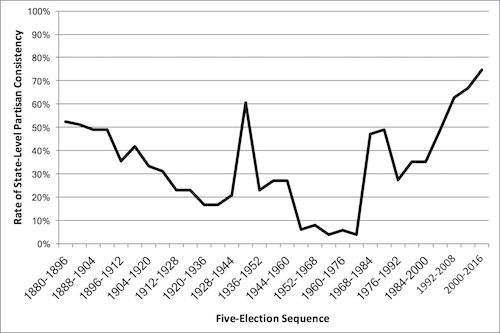
But the complete picture of the emerging electoral map in 2020 reveals far more continuity than change. The current era of presidential elections is distinguished by a historically unmatched degree of consistency in state-level partisan alignments, as depicted in this chart from my book Red Fighting Blue: How Geography and Electoral Rules Polarize American Politics:
Of the 37 states (plus the District of Columbia) that voted for the same party's nominees in each of the five presidential elections between 2000 and 2016, Arizona, Georgia, and Texas seem to be the only plausible candidates to break their streak in 2020—unless the next few months turn so dramatically in Donald Trump's favor that he manages to carry Minnesota or Maine. But even the potential addition of new Sun Belt territory to the familiar Midwest-centered battleground state map doesn't mean that there has been a significant partisan realignment of the South or Southwest over the past four years. What the close recent polls in these states really indicate is not that Trump has developed an unusual regional weakness, but rather that Biden now has a national lead strong enough to pull a few Republican-leaning states into the "competitive" category.
If we compare the two-party popular vote outcome in 2016 with today's two-party polling margin as estimated by The Economist's daily forecasting model for the 16 states where both parties received at least 45 percent of the vote in the last election, we see (after accounting for sampling error and variations in data quality) what looks like a fairly uniform pro-Democratic shift nationwide:
| New Mexico | Clinton +9 | Biden +13 | Change: +4 D |
| Virginia | Clinton +6 | Biden +11 | Change: +5 D |
| Colorado | Clinton +5 | Biden +14 | Change: +9 D |
| Maine | Clinton +3 | Biden +10 | Change: +7 D |
| Nevada | Clinton +3 | Biden +7 | Change: +4 D |
| Minnesota | Clinton +2 | Biden +9 | Change: +7 D |
| New Hampshire | Clinton +0 | Biden +6 | Change: +6 D |
| Michigan | Trump +0 | Biden +8 | Change: +8 D |
| Pennsylvania | Trump +1 | Biden +5 | Change: +6 D |
| Wisconsin | Trump +1 | Biden +6 | Change: +7 D |
| Florida | Trump +1 | Biden +4 | Change: +5 D |
| Arizona | Trump +4 | Biden +3 | Change: +7 D |
| North Carolina | Trump +4 | Biden +2 | Change: +6 D |
| Georgia | Trump +5 | Trump +0 | Change: +5 D |
| Ohio | Trump +9 | Biden +1 | Change: +10 D |
| Texas | Trump +9 | Trump +3 | Change: +6 D |
| Iowa | Trump +10 | Trump +2 | Change: +8 D |
| NATIONAL | Clinton +2 | Biden +8 | Change: +6 D |
Polling estimates are, of course, inexact, and all three of the new Sun Belt battlegrounds had already swum against the national tide by becoming "bluer" between 2012 and 2016. But the best recent evidence indicates that these states remain more Republican than the national average, and are currently competitive mostly because Biden is well ahead in the overall popular vote. Even so, Biden appears to have a consistent lead only in Arizona, and he still trails Trump in Texas.
If Biden's current advantage is changing the electoral map in some ways, it's working against change in others. After Trump won Ohio and Iowa by unusually wide margins in 2016, some analysts speculated that both states would lose battleground status in 2020, conceded to the GOP from the start of the campaign. Ohio and Iowa remain clearly Republican-leaning in 2020 compared to the nation as a whole, but Biden's overall lead allows him to keep both states in play (at least for now), and the Trump campaign is indeed spending money to defend them.
A scenario in which Biden maintains or expands his current margin would allow Democrats to consider deploying campaign resources into these states in pursuit of a decisive national victory and gains in downballot offices. But if the race starts to tighten, diverting attention to red-leaning states will be considerably less appealing, and Democratic dreams of "expanding the map" will need to wait for a future contest. Either way, the electoral college outcome in 2020 is still likely to pivot on the four states that Trump carried by narrow margins in 2016: Michigan, Pennsylvania, Wisconsin, and Florida. And there's nothing new at all about those particular states deciding who the next president will be.
Thursday, June 11, 2020
The Surge in Female Congressional Candidates Keeps Going in 2020—And Now It's Bipartisan
One of the major political events of 2018 was a sudden, historically unparalleled surge of women running for office—a development that reflected the energetic political mobilization of women within the Democratic Party after the election of Donald Trump over Hillary Clinton two years before. The Congress that took office in January 2019 contained a record 102 female members of the House of Representatives and 25 female senators. (Since then, the number of women has decreased by 1 in the House and increased by 1 in the Senate.) In both chambers, the partisan distribution is heavily skewed: Democratic women currently outnumber Republican women by a margin of 88 to 13 in the House and 17 to 9 in the Senate.
The congressional elections of 2020 have received much less notice than those of two years ago; apparently there are a few other big national stories to divert Americans' attention these days. But with slightly more than half of the year's House nominations having been decided by the primary voters of the two parties as of mid-June, it's worth checking in to see whether last election's explosive rise in female nominees has carried over to the current contest. As the figure below shows, the surge has not only continued among Democrats, it has spread to the Republican Party as well:

The share of female House nominees in the Democratic Party shot up from 29 percent in 2016 (itself a record at the time) to 42 percent in 2018; this year, it has increased still further to 48 percent as of this week—within reach of a numerically equal gender balance. The growth has been even sharper when incumbents, still a mostly male group, are excluded: from 27 percent in 2016 to 49.8 percent in 2018 to 58 percent (so far) in 2020. Whether or not the Democrats make history this year by nominating more total women than men for the House, they are on track to be the first party ever to nominate more non-incumbent women than non-incumbent men.
For Republicans, 2018 did not bring a sudden rise in female candidates. But 2020 very much did. So far this year, women constitute 21 percent of all Republican nominees for the House and 33 percent of all non-incumbent nominees—a dramatic increase from two years ago (when the final figures were 13 percent and 18 percent, respectively) and all previous years. The gap between the parties is still substantial, but is on track to narrow slightly from its 2018 size.
We'll need further research to know for sure, but I suspect that the dynamics driving these changes are somewhat different in each party. On the Democratic side, the Trump era has brought a sudden increase in women motivated to seek political power in response to his unexpected victory, combined with what appears to be an increasing preference among Democratic voters for female congressional nominees. In many strongly Republican districts that are not being seriously contested by the national parties, it seems that simply having a female name has often become a key ballot advantage for otherwise unknown Democratic candidates running among a field of equally unknown male primary opponents.
For Republicans, the new spike in female congressional nominees is more likely a product of initiatives by party leaders to recruit more women to run for office, in order to counteract a perceived reputation for demographic exclusivity. Republican officials have recently attempted to bring more gender diversity to the party, as reflected in the appointment over the past two years of three Republican women (Cindy Hyde-Smith of Mississippi, Martha McSally of Arizona, and Kelly Loeffler of Georgia) to fill vacant seats in the U.S. Senate.
Though women are much better represented on the candidate slates of both major parties than they have been in the past, the November election is unlikely to produce a 2021–2022 Congress with a large number of new female faces. Most challengers in congressional races are perennially destined to lose, and 2020 seems likely to be a more friendly election for incumbents than 2018 was. A few seats now held by retiring male representatives are likely to elect women this fall, including Iowa-2, Illinois-15, and Texas-24, but a few others may well replace departing women with male successors, including Alabama-2, Hawaii-2, and New York-17.
And in the Senate, it's quite possible that the number of women will actually decline in 2021. McSally and Loeffler both face serious challenges by male opponents in this fall's elections (two other electorally vulnerable incumbents, Susan Collins of Maine and Joni Ernst of Iowa, would be replaced by other women if they lose in November). At least five sitting senators—Kamala Harris of California, Amy Klobuchar of Minnesota, Elizabeth Warren of Massachusetts, Tammy Duckworth of Illinois, and Tammy Baldwin of Wisconsin—are plausible choices for the vice presidential slot on the Democratic national ticket, with no guarantee that a victorious running mate would be replaced in the Senate by another woman.
The only seat now occupied by a male senator that is more likely than not to elect a woman in 2020 is Wyoming, where Republican Cynthia Lummis is a heavy favorite to succeed the retiring Mike Enzi. Elsewhere, the female candidate with the best shot of winning a seat currently held by a man seems at this stage to be Democrat Barbara Bollier of Kansas, but she remains a clear underdog whose chances of winning a normally red state probably depend on the Republicans nominating a weak opponent in the August 4 primary. So while this year's congressional elections are shaping up to be a notable milestone in female representation within both major parties, next year's Congress will not be in position to make similar history.
The congressional elections of 2020 have received much less notice than those of two years ago; apparently there are a few other big national stories to divert Americans' attention these days. But with slightly more than half of the year's House nominations having been decided by the primary voters of the two parties as of mid-June, it's worth checking in to see whether last election's explosive rise in female nominees has carried over to the current contest. As the figure below shows, the surge has not only continued among Democrats, it has spread to the Republican Party as well:
The share of female House nominees in the Democratic Party shot up from 29 percent in 2016 (itself a record at the time) to 42 percent in 2018; this year, it has increased still further to 48 percent as of this week—within reach of a numerically equal gender balance. The growth has been even sharper when incumbents, still a mostly male group, are excluded: from 27 percent in 2016 to 49.8 percent in 2018 to 58 percent (so far) in 2020. Whether or not the Democrats make history this year by nominating more total women than men for the House, they are on track to be the first party ever to nominate more non-incumbent women than non-incumbent men.
For Republicans, 2018 did not bring a sudden rise in female candidates. But 2020 very much did. So far this year, women constitute 21 percent of all Republican nominees for the House and 33 percent of all non-incumbent nominees—a dramatic increase from two years ago (when the final figures were 13 percent and 18 percent, respectively) and all previous years. The gap between the parties is still substantial, but is on track to narrow slightly from its 2018 size.
We'll need further research to know for sure, but I suspect that the dynamics driving these changes are somewhat different in each party. On the Democratic side, the Trump era has brought a sudden increase in women motivated to seek political power in response to his unexpected victory, combined with what appears to be an increasing preference among Democratic voters for female congressional nominees. In many strongly Republican districts that are not being seriously contested by the national parties, it seems that simply having a female name has often become a key ballot advantage for otherwise unknown Democratic candidates running among a field of equally unknown male primary opponents.
For Republicans, the new spike in female congressional nominees is more likely a product of initiatives by party leaders to recruit more women to run for office, in order to counteract a perceived reputation for demographic exclusivity. Republican officials have recently attempted to bring more gender diversity to the party, as reflected in the appointment over the past two years of three Republican women (Cindy Hyde-Smith of Mississippi, Martha McSally of Arizona, and Kelly Loeffler of Georgia) to fill vacant seats in the U.S. Senate.
Though women are much better represented on the candidate slates of both major parties than they have been in the past, the November election is unlikely to produce a 2021–2022 Congress with a large number of new female faces. Most challengers in congressional races are perennially destined to lose, and 2020 seems likely to be a more friendly election for incumbents than 2018 was. A few seats now held by retiring male representatives are likely to elect women this fall, including Iowa-2, Illinois-15, and Texas-24, but a few others may well replace departing women with male successors, including Alabama-2, Hawaii-2, and New York-17.
And in the Senate, it's quite possible that the number of women will actually decline in 2021. McSally and Loeffler both face serious challenges by male opponents in this fall's elections (two other electorally vulnerable incumbents, Susan Collins of Maine and Joni Ernst of Iowa, would be replaced by other women if they lose in November). At least five sitting senators—Kamala Harris of California, Amy Klobuchar of Minnesota, Elizabeth Warren of Massachusetts, Tammy Duckworth of Illinois, and Tammy Baldwin of Wisconsin—are plausible choices for the vice presidential slot on the Democratic national ticket, with no guarantee that a victorious running mate would be replaced in the Senate by another woman.
The only seat now occupied by a male senator that is more likely than not to elect a woman in 2020 is Wyoming, where Republican Cynthia Lummis is a heavy favorite to succeed the retiring Mike Enzi. Elsewhere, the female candidate with the best shot of winning a seat currently held by a man seems at this stage to be Democrat Barbara Bollier of Kansas, but she remains a clear underdog whose chances of winning a normally red state probably depend on the Republicans nominating a weak opponent in the August 4 primary. So while this year's congressional elections are shaping up to be a notable milestone in female representation within both major parties, next year's Congress will not be in position to make similar history.
Thursday, June 04, 2020
Trump, the Floyd Protests, and the End of Confident Conservatism
After Richard Nixon's 1968 election, many conservatives came to believe that their movement naturally represented the political views of most Americans. This conservative faith in the wisdom of the average citizen was cemented by Ronald Reagan's popularity in the 1980s, which was widely interpreted at the time (and not just by conservatives) as a decisive expression of the nation's exhaustion with both outdated New Deal economic policies and decadent '60s-era cultural practices. America's mistaken dalliance with liberalism was a passing phase that it was maturing out of, argued the Reaganites, and both the present and future belonged to the right. Reagan himself projected this sunny confidence in the nation's judgment, serenely dismissing liberal expressions of outrage in the same manner that he responded to the attacks of the hapless Jimmy Carter by half-chuckling "there you go again."
Bill Clinton's presidency temporarily shook, but did not ultimately damage, the confidence of the conservative movement. Conservatives found ways to explain away Clinton's electoral success, claiming that he only won because George H. W. Bush had betrayed conservatism by raising taxes, because Ross Perot's independent candidacies temporarily drained conservative votes away from the Republican Party, and because Clinton's slippery political style deceived the electorate about his true nature. Republican capture of both houses of Congress in 1994 for the first time in four decades, combined with a similarly dramatic set of electoral gains at the state and local level, continued to suggest to conservatives that they represented the future of American politics, and several major milestones in the Clinton presidency, from the government shutdown of 1995–1996 to the impeachment of 1998–1999, were conflicts precipitated by conservative leaders who had assured themselves (sometimes incorrectly) that most of the public would side with them in a fight.
Despite the close margin, controversial resolution, and discrepancy between the popular and electoral votes, conservatives generally treated the 2000 election as something of a restoration after an eight-year usurpation, underlined by the fact that the new Republican president was the eldest son of the last Republican president. Especially after the declaration of the War on Terror, the presidency of George W. Bush styled itself as the authentic, patriotic voice of the vast American interior, and mocked its critics as a vocal but small group of coastal elites. Bush's top political aide Karl Rove repeatedly expressed ambitions to construct a durable Republican advantage in the manner of his political hero William McKinley, whose 1896 election marked the beginning of a 36-year stretch of Republican dominance of national politics.
With a few strategic concessions to the nation's changing demographic trends—education reform to appeal to suburban professional women, a softer tone on race and immigration to cultivate a Republican vote among Hispanics—the Bush program of "compassionate conservatism" envisioned a stable popular majority supporting a policy agenda of laissez-faire economics, religious traditionalism, and interventionist military engagements overseas. But the failures and misfortunes of Bush's second term opened the door to the election of Barack Obama in 2008. In retrospect, this was a key turning point in the psychology of the conservative movement.
Obama represented a new and more serious challenge to conservatism's conception of itself as uniquely speaking on behalf of the American public. His race was an important element of this threat, but not the only one. In contrast to Clinton's "triangulation" strategies and propensity to echo conservative tributes to limited government and personal responsibility, Obama made few substantive or symbolic concessions to conservatism. His policies were farther left than his predecessor's, and he succeeded in enacting health care reform where Clinton had failed. He was from Chicago, not small-town Arkansas. And he rode into office on the support of younger voters who represented the generational future of American politics, and who seemed especially resistant to the appeals of his conservative opponents.
Conservative confidence in the nation's long-term direction became notably scarce in the Obama years, as widespread pessimism and fear replaced Reagan's cheerful assuredness. The popular backlash on the right against the "change" that Obama himself claimed to personify was stronger than it had been against Clinton, taking aim at the traditional leadership of the Republican Party as well as the Democrats. Rather than selecting yet another member of the Bush family to succeed Obama, Republican primary voters opted to nominate Donald Trump, an outsider candidate who had built his campaign around passionate contempt for Obama and the state of the nation under his watch.
But whatever expressive purpose the decision to elect him may have served, the current president is ill-equipped to usher in a new conservative age. Trump is not a friendly face with the charisma to increase conservatism's mass appeal, like Reagan was. He is not a man with a 40-year plan, like Rove was. And any hopes that his glowering demeanor and vengeful preoccupations would either intimidate liberals into silence or halt the progression of larger social changes have clearly not been realized. In part because Trump has inspired a backlash of his own, conservatives do not seem much more comfortable with the direction of America today than they were four years ago.
The waning confidence of the American right in its own popular standing has produced other manifestations as well. Its imprint can be seen in conservative opposition to measures designed to increase the ease of voting, in negative portrayals of "millennials" and college students in the conservative media, and in an increased emphasis on the unelected federal judicial branch, rather than the congressional legislative process, as an avenue for conservative policy-making. Perhaps most dramatically, it is expressed by the more frequent displays of firearms at conservative protest events—a clear suggestion that the use or threat of physical force might be necessary to compensate for losses in the court of public opinion.
The current crisis in the streets of America has roots that stretch in many different directions, but it has surely been exacerbated by the current administration's propensity for confrontation with the many perceived enemies that surround it. It's not especially important that Trump apparently moved briefly to the bunker under the White House last week in the face of protests outside the building—a subject of liberal mockery in recent days—but it's crucial that the administration's governing approach from its inception has reflected a bunker mentality. The protestors gathering daily outside the White House and in cities and towns all around the country since the George Floyd killing have come to embody the threat of cultural besiegement that many conservatives, including those in law enforcement professions, have been feeling since 2008.
Trump has started to echo Nixon's famous invocation of a supportive "silent majority." But he is the only president in the history of public opinion polling who has never had a majority of Americans on his side, even on his first day in office, and he has never shown much interest in courting skeptics rather than attacking them. Winning a second term will likely require him to eke out a narrow margin in the electoral college, very possibly without a popular-vote plurality once again. The current governing regime seeks to retain political power from behind barricades that are primarily psychological, separated in spirit more than in physical distance from a growing population of fellow Americans whom it no longer trusts to be on its side. When you see your own domestic political opponents as an irredeemably hostile force trying to destroy the country as you know it, perhaps it's only natural to fantasize about calling in the troops.
Bill Clinton's presidency temporarily shook, but did not ultimately damage, the confidence of the conservative movement. Conservatives found ways to explain away Clinton's electoral success, claiming that he only won because George H. W. Bush had betrayed conservatism by raising taxes, because Ross Perot's independent candidacies temporarily drained conservative votes away from the Republican Party, and because Clinton's slippery political style deceived the electorate about his true nature. Republican capture of both houses of Congress in 1994 for the first time in four decades, combined with a similarly dramatic set of electoral gains at the state and local level, continued to suggest to conservatives that they represented the future of American politics, and several major milestones in the Clinton presidency, from the government shutdown of 1995–1996 to the impeachment of 1998–1999, were conflicts precipitated by conservative leaders who had assured themselves (sometimes incorrectly) that most of the public would side with them in a fight.
Despite the close margin, controversial resolution, and discrepancy between the popular and electoral votes, conservatives generally treated the 2000 election as something of a restoration after an eight-year usurpation, underlined by the fact that the new Republican president was the eldest son of the last Republican president. Especially after the declaration of the War on Terror, the presidency of George W. Bush styled itself as the authentic, patriotic voice of the vast American interior, and mocked its critics as a vocal but small group of coastal elites. Bush's top political aide Karl Rove repeatedly expressed ambitions to construct a durable Republican advantage in the manner of his political hero William McKinley, whose 1896 election marked the beginning of a 36-year stretch of Republican dominance of national politics.
With a few strategic concessions to the nation's changing demographic trends—education reform to appeal to suburban professional women, a softer tone on race and immigration to cultivate a Republican vote among Hispanics—the Bush program of "compassionate conservatism" envisioned a stable popular majority supporting a policy agenda of laissez-faire economics, religious traditionalism, and interventionist military engagements overseas. But the failures and misfortunes of Bush's second term opened the door to the election of Barack Obama in 2008. In retrospect, this was a key turning point in the psychology of the conservative movement.
Obama represented a new and more serious challenge to conservatism's conception of itself as uniquely speaking on behalf of the American public. His race was an important element of this threat, but not the only one. In contrast to Clinton's "triangulation" strategies and propensity to echo conservative tributes to limited government and personal responsibility, Obama made few substantive or symbolic concessions to conservatism. His policies were farther left than his predecessor's, and he succeeded in enacting health care reform where Clinton had failed. He was from Chicago, not small-town Arkansas. And he rode into office on the support of younger voters who represented the generational future of American politics, and who seemed especially resistant to the appeals of his conservative opponents.
Conservative confidence in the nation's long-term direction became notably scarce in the Obama years, as widespread pessimism and fear replaced Reagan's cheerful assuredness. The popular backlash on the right against the "change" that Obama himself claimed to personify was stronger than it had been against Clinton, taking aim at the traditional leadership of the Republican Party as well as the Democrats. Rather than selecting yet another member of the Bush family to succeed Obama, Republican primary voters opted to nominate Donald Trump, an outsider candidate who had built his campaign around passionate contempt for Obama and the state of the nation under his watch.
But whatever expressive purpose the decision to elect him may have served, the current president is ill-equipped to usher in a new conservative age. Trump is not a friendly face with the charisma to increase conservatism's mass appeal, like Reagan was. He is not a man with a 40-year plan, like Rove was. And any hopes that his glowering demeanor and vengeful preoccupations would either intimidate liberals into silence or halt the progression of larger social changes have clearly not been realized. In part because Trump has inspired a backlash of his own, conservatives do not seem much more comfortable with the direction of America today than they were four years ago.
The waning confidence of the American right in its own popular standing has produced other manifestations as well. Its imprint can be seen in conservative opposition to measures designed to increase the ease of voting, in negative portrayals of "millennials" and college students in the conservative media, and in an increased emphasis on the unelected federal judicial branch, rather than the congressional legislative process, as an avenue for conservative policy-making. Perhaps most dramatically, it is expressed by the more frequent displays of firearms at conservative protest events—a clear suggestion that the use or threat of physical force might be necessary to compensate for losses in the court of public opinion.
The current crisis in the streets of America has roots that stretch in many different directions, but it has surely been exacerbated by the current administration's propensity for confrontation with the many perceived enemies that surround it. It's not especially important that Trump apparently moved briefly to the bunker under the White House last week in the face of protests outside the building—a subject of liberal mockery in recent days—but it's crucial that the administration's governing approach from its inception has reflected a bunker mentality. The protestors gathering daily outside the White House and in cities and towns all around the country since the George Floyd killing have come to embody the threat of cultural besiegement that many conservatives, including those in law enforcement professions, have been feeling since 2008.
Trump has started to echo Nixon's famous invocation of a supportive "silent majority." But he is the only president in the history of public opinion polling who has never had a majority of Americans on his side, even on his first day in office, and he has never shown much interest in courting skeptics rather than attacking them. Winning a second term will likely require him to eke out a narrow margin in the electoral college, very possibly without a popular-vote plurality once again. The current governing regime seeks to retain political power from behind barricades that are primarily psychological, separated in spirit more than in physical distance from a growing population of fellow Americans whom it no longer trusts to be on its side. When you see your own domestic political opponents as an irredeemably hostile force trying to destroy the country as you know it, perhaps it's only natural to fantasize about calling in the troops.
Tuesday, May 26, 2020
Why COVID Was Never Going to Produce National Unity
The presidency of Donald Trump is often treated as if it represents a dramatic new development in American politics, but it's likely that future generations looking back on this time in history will be somewhat surprised, or even amused, by the prevalence of such a view. In many ways, Trump is more interesting, or important, as a fulfillment of existing trends reaching back decades into the past than he is as an innovator in his own right. In retrospect, a Trump-like figure rising to power within the Republican Party can, and probably will, be seen as a completely natural development.
The current historical moment is merely the point at which the barrier previously separating the increasingly-dominant media wing of the American conservative movement from its traditional officeholding wing suffered a serious structural buckle, catapulting many of the media types—with their distinctive preoccupations, motivations, and rhetorical styles—into positions of governing power. Put another way, the Trump administration is more or less a real-life simulation of what would have happened if Rush Limbaugh had been elected president. Journalists and attentive citizens often gasp at this or that example of "unprecedented" Trumpian behavior and marvel that they can't picture Barack Obama—or George W. Bush, or Ronald Reagan—ever saying or doing such a thing. But if the question were instead "can you imagine a President Limbaugh saying or doing that?" the answer is nearly always yes.
Many observers have expressed amazement at how quickly the nationwide public health crisis of COVID-19, itself not inherently an ideological or divisive issue, has evolved to conform to the outline of familiar culture-war conflicts. But to the media outlets that now exercise substantial influence over the national Republican Party, culture war is what politics is all about. In the world that they construct for their audiences, conservatism is in the position of defending America itself against ceaseless attack from Democratic politicians, liberal interests, and a mainstream news media all bent on its destruction or catastrophic transformation. In this constant state of emergency, there is little room to prize non-ideological values such as governing competence or policy expertise, and any form of compromise with the political opposition is tantamount to capitulation.
Even during periods of Republican rule, the content of conservative media programming focuses more on criticizing Democrats and the non-conservative media than on celebrating conservative electoral or governing successes. An emergence of national unity, with the leaders and members of both parties agreeing to implement public policies developed by non-partisan experts to address a widespread threat to the well-being of all citizens, wouldn't just undercut the arguments that liberals are wrong about everything and that government power cannot be leveraged productively for universal benefit. It's even worse than that: what would the conservative media talk about every day?
Trump's own instincts lie in the same direction. Unlike previous leaders of both parties, he ran for the presidency not by vowing to bring the country together but instead by promising constant conflict with an array of perceived enemies inside as well as outside its borders. Intermittent expectations that Trump might seek to "rise above" mere political warfare were thus unrealistic: in his view, the warfare is the whole point. The idea of approaching the current crisis with a bipartisan spirit is as incomprehensible to him as it would be to any Fox News host, and both Fox and the White House have quickly reverted to their common comfort zone of the partisan firing range: questioning the need for social distancing restrictions and even the severity of the disease itself while accusing Democrats, journalists, and scientists of using the crisis as a cover to sabotage the president.
But an important difference remains between officeholding conservatives and media figures: talking heads don't need to win over a plurality of eyeballs to build long and successful careers, but politicians can only stay in power by attracting more votes, whether popular or electoral, than the other side. The all-culture-war-all-the-time attitude is more reliable as a means of building a loyal audience in a splintered media marketplace than as a national campaign strategy. Trump is openly envious of the governors who have received a post-COVID boost in personal approval ratings that has eluded him, but the facts-first, inclusive governing approach that citizens have rewarded across party lines at the state and local level is simply not in his nature to adopt regardless of its potential electoral benefits.
Trump's current situation is reminiscent of the time that ESPN hired Rush Limbaugh to provide commentary on its highly-rated "NFL Countdown" pregame show. Limbaugh's tenure only lasted about a month, ending abruptly after he used his new platform to argue that mainstream sports media analysts were reluctant to criticize the performance of Philadelphia Eagles quarterback Donovan McNabb because McNabb was black. Limbaugh, a lifelong sports fan, undoubtedly recognized what a valuable opportunity he was being provided, and that his new bosses would be expecting him to justify their controversial decision to bring him aboard by showing that he was capable of being more than an incendiary political warrior. But, like Trump, Limbaugh just couldn't help himself once the camera was pointed at him. His life’s purpose is to say these things, and these are the only kind of things he knows how to say.
The current historical moment is merely the point at which the barrier previously separating the increasingly-dominant media wing of the American conservative movement from its traditional officeholding wing suffered a serious structural buckle, catapulting many of the media types—with their distinctive preoccupations, motivations, and rhetorical styles—into positions of governing power. Put another way, the Trump administration is more or less a real-life simulation of what would have happened if Rush Limbaugh had been elected president. Journalists and attentive citizens often gasp at this or that example of "unprecedented" Trumpian behavior and marvel that they can't picture Barack Obama—or George W. Bush, or Ronald Reagan—ever saying or doing such a thing. But if the question were instead "can you imagine a President Limbaugh saying or doing that?" the answer is nearly always yes.
Many observers have expressed amazement at how quickly the nationwide public health crisis of COVID-19, itself not inherently an ideological or divisive issue, has evolved to conform to the outline of familiar culture-war conflicts. But to the media outlets that now exercise substantial influence over the national Republican Party, culture war is what politics is all about. In the world that they construct for their audiences, conservatism is in the position of defending America itself against ceaseless attack from Democratic politicians, liberal interests, and a mainstream news media all bent on its destruction or catastrophic transformation. In this constant state of emergency, there is little room to prize non-ideological values such as governing competence or policy expertise, and any form of compromise with the political opposition is tantamount to capitulation.
Even during periods of Republican rule, the content of conservative media programming focuses more on criticizing Democrats and the non-conservative media than on celebrating conservative electoral or governing successes. An emergence of national unity, with the leaders and members of both parties agreeing to implement public policies developed by non-partisan experts to address a widespread threat to the well-being of all citizens, wouldn't just undercut the arguments that liberals are wrong about everything and that government power cannot be leveraged productively for universal benefit. It's even worse than that: what would the conservative media talk about every day?
Trump's own instincts lie in the same direction. Unlike previous leaders of both parties, he ran for the presidency not by vowing to bring the country together but instead by promising constant conflict with an array of perceived enemies inside as well as outside its borders. Intermittent expectations that Trump might seek to "rise above" mere political warfare were thus unrealistic: in his view, the warfare is the whole point. The idea of approaching the current crisis with a bipartisan spirit is as incomprehensible to him as it would be to any Fox News host, and both Fox and the White House have quickly reverted to their common comfort zone of the partisan firing range: questioning the need for social distancing restrictions and even the severity of the disease itself while accusing Democrats, journalists, and scientists of using the crisis as a cover to sabotage the president.
But an important difference remains between officeholding conservatives and media figures: talking heads don't need to win over a plurality of eyeballs to build long and successful careers, but politicians can only stay in power by attracting more votes, whether popular or electoral, than the other side. The all-culture-war-all-the-time attitude is more reliable as a means of building a loyal audience in a splintered media marketplace than as a national campaign strategy. Trump is openly envious of the governors who have received a post-COVID boost in personal approval ratings that has eluded him, but the facts-first, inclusive governing approach that citizens have rewarded across party lines at the state and local level is simply not in his nature to adopt regardless of its potential electoral benefits.
Trump's current situation is reminiscent of the time that ESPN hired Rush Limbaugh to provide commentary on its highly-rated "NFL Countdown" pregame show. Limbaugh's tenure only lasted about a month, ending abruptly after he used his new platform to argue that mainstream sports media analysts were reluctant to criticize the performance of Philadelphia Eagles quarterback Donovan McNabb because McNabb was black. Limbaugh, a lifelong sports fan, undoubtedly recognized what a valuable opportunity he was being provided, and that his new bosses would be expecting him to justify their controversial decision to bring him aboard by showing that he was capable of being more than an incendiary political warrior. But, like Trump, Limbaugh just couldn't help himself once the camera was pointed at him. His life’s purpose is to say these things, and these are the only kind of things he knows how to say.
Tuesday, April 28, 2020
The Weakest Modern Presidency Faces a Pandemic From the Couch
For three years now, political scientists Jonathan Bernstein and Matt Glassman have been arguing that Donald Trump is a historically weak president—probably the weakest of the modern (post-FDR) presidents. This is a contrarian view in some respects. Trump dominates the day-to-day media coverage of politics like no other figure in memory, and even many of his harshest critics often describe him as ruthlessly wielding the power of his office.
But I suspect that this argument will become more popular over time, especially once Trump departs the presidency and is no longer the constant obsession of the political world. Even prior to the current emergency, Trump had rarely been invested in the substantive responsibilities of his office and had never been able to attract sustained popular support for himself or his policies. He has presided over an executive branch whose administrative and political capacity has been constrained by mismanagement, infighting, and a cast of substandard subordinates serving alongside an array of temporary appointees and outright vacancies. While other presidents learned on the job from early mistakes, Trump has seemed incapable of significant growth or adaptation.
The COVID-19 crisis has exposed this weakness to public view like no previous event. Other than signing economic aid legislation for citizens and businesses—initiatives that were chiefly negotiated by Treasury Secretary Mnuchin and congressional Democrats with little personal involvement by the president—Trump does not appear to be leading an ambitious national response to the epidemic. Governors and other state officials complain of insufficient federal assistance (and even active federal interference). According to recent reporting, Trump is unengaged with the substance of his administration's COVID mitigation efforts: his discursive appearances at task force meetings reveal a limited understanding of relevant subjects when he attends at all, and he spends much of the workday watching cable television.
Trump has angrily disputed these accounts, suggesting that he may be the hardest-working president in history. But the amount of time that he has visibly devoted to complaining on Twitter or holding extended press briefings is evidence enough of where his attention has been directed. Though they were initially assumed to be politically beneficial, the president's daily briefings have only turned out to advertise his limitations, impressing nobody who wasn't already a supporter. It's thus understandable that Trump's post-COVID bump in job approval was both comparatively modest and unusually short-lived.
Unlike the governors and mayors who are earning public support across party lines for their handling of the crisis, Trump seems incapable of understanding that projecting strength requires exhibiting intellectual command of the facts and toning down personal grievances. Rather than learning from experience, he repeats the same mistakes over and over: claiming that the virus will "just go away," touting unproven or nonsensical remedies, and making quickly-falsified predictions about how long the crisis will continue or how many Americans will die. And the president has repeatedly shifted responsibility for solving the problem from himself to state and local officials—quite a departure from the "I alone can fix it" rhetoric of the 2016 campaign.
The fundamental passivity of the president's response to COVID-19 is especially instructive given his normal preoccupation with projecting executive decisiveness, populist sympathies, and Type-A swagger. Trump's desire to comport to the ultimate "strong leader" archetype is indeed powerful, but not so powerful that it can overcome a limited interest in information-gathering, an inability to think strategically over the long term, a lack of mental focus on any subject other than himself, and a general absence of committed energy for the tasks of governing.
All of these traits were visible before COVID came along. But now the demands on this presidency have grown stronger while the president looks less and less comfortable in the job, unable even to mimic the seriousness of purpose that other elected officials have marshaled in the moment. He seems to be hoping that he will wake up one day and the virus will simply be gone—via miracle cure or act of providence—without the need for any dedication or sacrifice on his part. That's admittedly a relatable wish, but it's not how a strong president would act.
But I suspect that this argument will become more popular over time, especially once Trump departs the presidency and is no longer the constant obsession of the political world. Even prior to the current emergency, Trump had rarely been invested in the substantive responsibilities of his office and had never been able to attract sustained popular support for himself or his policies. He has presided over an executive branch whose administrative and political capacity has been constrained by mismanagement, infighting, and a cast of substandard subordinates serving alongside an array of temporary appointees and outright vacancies. While other presidents learned on the job from early mistakes, Trump has seemed incapable of significant growth or adaptation.
The COVID-19 crisis has exposed this weakness to public view like no previous event. Other than signing economic aid legislation for citizens and businesses—initiatives that were chiefly negotiated by Treasury Secretary Mnuchin and congressional Democrats with little personal involvement by the president—Trump does not appear to be leading an ambitious national response to the epidemic. Governors and other state officials complain of insufficient federal assistance (and even active federal interference). According to recent reporting, Trump is unengaged with the substance of his administration's COVID mitigation efforts: his discursive appearances at task force meetings reveal a limited understanding of relevant subjects when he attends at all, and he spends much of the workday watching cable television.
Trump has angrily disputed these accounts, suggesting that he may be the hardest-working president in history. But the amount of time that he has visibly devoted to complaining on Twitter or holding extended press briefings is evidence enough of where his attention has been directed. Though they were initially assumed to be politically beneficial, the president's daily briefings have only turned out to advertise his limitations, impressing nobody who wasn't already a supporter. It's thus understandable that Trump's post-COVID bump in job approval was both comparatively modest and unusually short-lived.
Unlike the governors and mayors who are earning public support across party lines for their handling of the crisis, Trump seems incapable of understanding that projecting strength requires exhibiting intellectual command of the facts and toning down personal grievances. Rather than learning from experience, he repeats the same mistakes over and over: claiming that the virus will "just go away," touting unproven or nonsensical remedies, and making quickly-falsified predictions about how long the crisis will continue or how many Americans will die. And the president has repeatedly shifted responsibility for solving the problem from himself to state and local officials—quite a departure from the "I alone can fix it" rhetoric of the 2016 campaign.
The fundamental passivity of the president's response to COVID-19 is especially instructive given his normal preoccupation with projecting executive decisiveness, populist sympathies, and Type-A swagger. Trump's desire to comport to the ultimate "strong leader" archetype is indeed powerful, but not so powerful that it can overcome a limited interest in information-gathering, an inability to think strategically over the long term, a lack of mental focus on any subject other than himself, and a general absence of committed energy for the tasks of governing.
All of these traits were visible before COVID came along. But now the demands on this presidency have grown stronger while the president looks less and less comfortable in the job, unable even to mimic the seriousness of purpose that other elected officials have marshaled in the moment. He seems to be hoping that he will wake up one day and the virus will simply be gone—via miracle cure or act of providence—without the need for any dedication or sacrifice on his part. That's admittedly a relatable wish, but it's not how a strong president would act.
Wednesday, April 15, 2020
Solving the COVID Crisis Requires Bipartisanship, But the Modern GOP Isn't Built for It
American politics is famously polarized these days, but it's hard to envision any solution to the COVID pandemic and associated economic crisis that doesn't require a lot of bipartisan agreement. Democratic and Republican officeholders need to cooperate in order to enact economic aid legislation and other measures designed to ameliorate the effects of the outbreak. Supporters of both parties need to respect the authority of state and local officials to impose restrictions on public gatherings in order to slow the spread of the virus. And the future expiration of these stay-at-home orders will not produce an economic rebound unless Democrats as well as Republicans feel safe enough to resume their normal consumption activities.
As my political science colleague Frances Lee points out in Insecure Majorities, her excellent book on the modern Congress, breakdowns in bipartisanship often benefit the party out of power, by denying the ruling side the policy achievements and broad popular legitimacy that it would gain from productive cooperation. Tamping down partisan divisions in order to focus on fighting the virus and helping those affected by the deteriorating economy thus especially serves the interest of the Republican Party, the current holder of the presidency. November's election will serve as an unavoidable referendum on President Trump, and citizens' perceptions of his performance in handling the COVID crisis will not only influence the outcome of the presidential race but will extend to congressional and even state-level contests as well.
Under the current circumstances, then, we might expect an incumbent president to pursue a strategy of staying above the partisan fray, reassuring Americans of all political preferences that he was committed to protecting both their health and their wealth from the current threats while finding some common ground with the leaders of the opposition. But Trump's instincts—especially in moments of potential vulnerability—compel him to attack his perceived enemies and ratchet up the general level of conflict. He has even suggested at times that he will condition federal aid to states and localities on the amount of deference he receives from their elected officials. There has been no apparent attempt by his administration to build credibility with the public outside the 45 percent or so of Americans who already like and trust the president.
Trump's personality is what it is. But his combative style is shared by many of his partisan allies. Other major elements of the Republican party network, such as conservative interest groups and the conservative media universe, are increasingly promoting Trump's position that the threat of the coronavirus is exaggerated and that prevailing social distancing restrictions are excessive. Familiar Republican targets—not only Democratic politicians but also scientific experts and the mainstream media—are under fresh attack from an American right that has become suddenly anxious about the president's chances of re-election during conditions of national economic catastrophe.
The contemporary Republican Party has been built to wage ideological and partisan conflict more than to manage the government or solve specific social problems. So perhaps it shouldn't be shocking that an array of subjects, from what medical treatment might help COVID patients to how important it is to take measures protecting the lives of the elderly, have been drawn into the perpetual political wars. But leading conservative figures like Trump, Sean Hannity, and the Heritage Foundation will find it much easier to persuade existing supporters to take their side in a fight with "liberal" scientists, journalists, and public safety authorities than to win over the American public as a whole.
Republicans need a party-wide reset of priorities. There has seldom been a time in recent political history when daily partisan point-scoring has been rendered more irrelevant. The general election is far enough away that good policy is good politics: the best way for the ruling party to serve its own electoral interests is to work as hard as possible over the next seven months to render COVID manageable and prevent economic freefall. The widespread public confidence that will be necessary for "normal life" to resume simply can't be jawboned back into existence via daily press conferences, radio broadcasts, or Fox News monologues. If Republicans lose the battle with the coronavirus, they won't have much of a chance to win the fight against liberalism.
As my political science colleague Frances Lee points out in Insecure Majorities, her excellent book on the modern Congress, breakdowns in bipartisanship often benefit the party out of power, by denying the ruling side the policy achievements and broad popular legitimacy that it would gain from productive cooperation. Tamping down partisan divisions in order to focus on fighting the virus and helping those affected by the deteriorating economy thus especially serves the interest of the Republican Party, the current holder of the presidency. November's election will serve as an unavoidable referendum on President Trump, and citizens' perceptions of his performance in handling the COVID crisis will not only influence the outcome of the presidential race but will extend to congressional and even state-level contests as well.
Under the current circumstances, then, we might expect an incumbent president to pursue a strategy of staying above the partisan fray, reassuring Americans of all political preferences that he was committed to protecting both their health and their wealth from the current threats while finding some common ground with the leaders of the opposition. But Trump's instincts—especially in moments of potential vulnerability—compel him to attack his perceived enemies and ratchet up the general level of conflict. He has even suggested at times that he will condition federal aid to states and localities on the amount of deference he receives from their elected officials. There has been no apparent attempt by his administration to build credibility with the public outside the 45 percent or so of Americans who already like and trust the president.
Trump's personality is what it is. But his combative style is shared by many of his partisan allies. Other major elements of the Republican party network, such as conservative interest groups and the conservative media universe, are increasingly promoting Trump's position that the threat of the coronavirus is exaggerated and that prevailing social distancing restrictions are excessive. Familiar Republican targets—not only Democratic politicians but also scientific experts and the mainstream media—are under fresh attack from an American right that has become suddenly anxious about the president's chances of re-election during conditions of national economic catastrophe.
The contemporary Republican Party has been built to wage ideological and partisan conflict more than to manage the government or solve specific social problems. So perhaps it shouldn't be shocking that an array of subjects, from what medical treatment might help COVID patients to how important it is to take measures protecting the lives of the elderly, have been drawn into the perpetual political wars. But leading conservative figures like Trump, Sean Hannity, and the Heritage Foundation will find it much easier to persuade existing supporters to take their side in a fight with "liberal" scientists, journalists, and public safety authorities than to win over the American public as a whole.
Republicans need a party-wide reset of priorities. There has seldom been a time in recent political history when daily partisan point-scoring has been rendered more irrelevant. The general election is far enough away that good policy is good politics: the best way for the ruling party to serve its own electoral interests is to work as hard as possible over the next seven months to render COVID manageable and prevent economic freefall. The widespread public confidence that will be necessary for "normal life" to resume simply can't be jawboned back into existence via daily press conferences, radio broadcasts, or Fox News monologues. If Republicans lose the battle with the coronavirus, they won't have much of a chance to win the fight against liberalism.
Wednesday, April 08, 2020
Sanders Was a Big Step Forward for Leftism—But Where Does It Go From Here?
Bernie Sanders officially suspended his 2020 presidential campaign on Wednesday, choosing not to contest the Democratic primaries all the way to the end of the calendar as he had done in 2016. It may seem in retrospect as if Sanders's second campaign was less successful than his first, since his support fell below its 2016 level in every state that voted after Super Tuesday and he dropped out of the race much sooner this time around. Yet Sanders achieved something important in 2020 that he never did four years ago: a temporary status as the favorite for the nomination during the two-and-a-half weeks between the New Hampshire and South Carolina primaries, before Joe Biden's sudden resurgence blocked his path. It's likely that Sanders's two presidential bids, taken together, represent an important milestone in American politics. But it's impossible to know right now how important they will turn out to be.
After each of his candidacies, some analysts confidently declared that Sanders—despite his present-day defeats—nevertheless represents the future of the Democratic Party. This blog has consistently been skeptical of that argument, and it remains so today. Even if Sanders had managed to win the 2020 race, it would have been a testament to the complexities and contingencies of multi-candidate nomination politics more than the expression of a fundamental shift in the preferences of Democratic voters. And if Sanders had gone on to lose the general election to Donald Trump, there would have been substantial backlash within the party against his brand of politics.
Sanders found more success running for president than many people anticipated—and more success than any left-wing candidate achieved since Jesse Jackson, if not George McGovern. But as these historical parallels suggest, temporary breakthroughs do not inevitably lead to long-term transformations. Sanders has given leftism (a word I use in a non-pejorative sense to distinguish Sanders-style politics from the conventional Obama-Biden liberalism now prevailing within the Democratic mainstream) its best opportunity in at least a generation to establish itself as a persistently influential force in American politics, even if it remains unlikely to succeed in remaking the entire Democratic Party in its own image. But opportunities can be squandered, and they often have been before.
Sanders's most obvious contribution to the leftist cause is demonstrating that millions of Americans can be mobilized to support—and support passionately, with generous financial contributions—a political candidate who identifies himself as a socialist and who advocates a comprehensively left-wing set of issue positions that would, especially in the economic realm, represent a break from the thrust of American policy-making over at least the past 40 years. He diverted the attention of activists on the left who have often remained aloof from electoral politics to the potential benefits of seeking power through that means. And he (very sensibly) used the vehicle of a major party to do so, illustrating the self-defeating pointlessness of leftism's previous third-party dalliances by winning nearly four times as many total votes in one-and-a-half nomination contests as the Green Party has won over the past six general elections.
Sanders also introduced new or long-absent policy positions into the realm of public debate. Whether or not student debt forgiveness, a federal jobs guarantee, or six months of paid family leave are ever implemented in the United States, the necessary first step toward enactment is for a candidate to build a campaign around them. A political journalistic class that does not naturally welcome discussions of economic inequality and fairness has been compelled by Sanders's campaigns to acknowledge these subjects to a much greater degree than it did in preceding decades.
But Sanders also exposed some of the continued political weakness of American leftism even in a moment of relative triumph, so it's worth considering what else would need to happen for his candidacies to become the start of a larger revolution (as it were). Simply pointing at the age distribution of Sanders's support and claiming that the left wing can just wait to inherit the Democratic Party from its more moderate elders isn't very convincing. At any given historical moment, lefties can be prone to assuming that the enthusiasm of youthful activists for their cause is a sign that popular victory is just around the generational corner, but it's worth considering how many baby boomers who were marching in the streets in the 1960s and 1970s aged to become supporters of Joe Biden—or, for that matter, of Donald Trump.
While Sanders did much to promote the idea that left-wing politics could be productively advanced within the institutional framework of the Democratic Party, he did not entirely resolve—and, in some ways, even exacerbated—the tension between corners of the activist left and the party as it now exists. Sanders's refusal to officially become a Democrat himself, combined with his rhetorical attacks on the "Democratic establishment," meant that he couldn't speak of the party as a "we" rather than a "they," which contrasted with other leaders (such as Elizabeth Warren and Alexandria Ocasio-Cortez) whose policy views overlap with Sanders but who present themselves as heirs to the left's lineage within the Democratic Party rather than outside it.
For those on the left who disdain the Democratic name, this separation was a major reason why Sanders was preferable to alternatives like Warren. In both 2016 and 2020, Sanders ran better among political independents than among self-identified Democrats. Some of his most prominent and devoted public supporters, and even campaign staff members, have histories of open antagonism to Democratic leaders and organizations. But increasing the appeal of leftist politics within the Democratic electoral base in the future will require courting citizens who are loyal to the party and proud of its history—such as the black voters whose lack of support for Sanders proved decisive in both of the last two elections. The modern conservative movement gained control of the Republican Party not by dismissing the GOP's heritage but by claiming it for itself. Yet analogous actors on the left have been much more likely to criticize the Democratic leadership from outside the tent, limiting their persuasive power over those inside.
Another question still unanswered at this stage is whether momentum on the left will survive the end of Sanders's own national candidacy. Sanders is famous for his lack of interest in promoting or even talking about himself, but insurgent or upstart presidential campaigns often wind up presenting their candidates as political saviors who have arrived on the scene to personally cure the nation's ills, and—as with Obama and Trump before him—Sanders has indeed become such a figure, treated by some admirers as the only honest man in politics. Both Sanders campaigns styled themselves as a "movement," but can this movement extend beyond Sanders, his current activist supporters, and a handful of backbench allies in the House of Representatives?
One might be tempted to compare Sanders to Barry Goldwater, whose own unsuccessful presidential candidacy laid the groundwork for later transformational change, but the modern conservative movement was already much larger than one candidate or campaign by the time of Goldwater's 1964 nomination, and only two years after his general election defeat it elected its ultimate embodiment, Ronald Reagan, to be governor of the nation's largest state. Sanders has been a very effective spokesperson for his cause, but he does not seem to be a natural institution-builder, and an enduring political movement or party faction needs renewable capacity beyond the intermittent mobilization of quadrennial presidential campaigns. Here, as elsewhere, the conservative movement's ability to draw steady financial and structural support from business interests and wealthy patrons has given it an advantage that is difficult to replicate on the left.
The Sanders campaign was also ultimately hampered by another common impediment of left-wing politics: strategic and tactical deficiencies. Lefties can easily fall into the habit of waging campaigns in the political world as they wish it to be, not in the world as it is. They may also avoid practices that they consider unseemly, even if they might be effective. Post-mortem accounts of the Sanders operation describe flawed or absent polling, considerable strategic rigidity, and a candidate disinclined to reach out to other political figures who would have been in position to help him win. (The Warren campaign also seems to have been organized around the idea that relying on pollsters and professional consultants to make major decisions was somehow beneath its dignity and therefore to be resisted.) Romanticizing the noble defeat is a long-standing tradition on the American left, but it has undeniable practical drawbacks if the goal is to gain and hold political power.
Sanders has already left a mark on aspects of the Democratic policy platform, and he will almost certainly be credited in coming years with drawing a generation of activists into the political arena. Rather than exerting a transformative effect on the party as a whole, a more invigorated left wing is—if it can sustain its energy over the long term—more likely to act as one among many constituencies tugging on Democratic leaders to prioritize its particular concerns. Though such a development would fall well short of some supporters' revolutionary ambitions, it would be still a fairly impressive legacy for a second-place campaign to leave behind.
After each of his candidacies, some analysts confidently declared that Sanders—despite his present-day defeats—nevertheless represents the future of the Democratic Party. This blog has consistently been skeptical of that argument, and it remains so today. Even if Sanders had managed to win the 2020 race, it would have been a testament to the complexities and contingencies of multi-candidate nomination politics more than the expression of a fundamental shift in the preferences of Democratic voters. And if Sanders had gone on to lose the general election to Donald Trump, there would have been substantial backlash within the party against his brand of politics.
Sanders found more success running for president than many people anticipated—and more success than any left-wing candidate achieved since Jesse Jackson, if not George McGovern. But as these historical parallels suggest, temporary breakthroughs do not inevitably lead to long-term transformations. Sanders has given leftism (a word I use in a non-pejorative sense to distinguish Sanders-style politics from the conventional Obama-Biden liberalism now prevailing within the Democratic mainstream) its best opportunity in at least a generation to establish itself as a persistently influential force in American politics, even if it remains unlikely to succeed in remaking the entire Democratic Party in its own image. But opportunities can be squandered, and they often have been before.
Sanders's most obvious contribution to the leftist cause is demonstrating that millions of Americans can be mobilized to support—and support passionately, with generous financial contributions—a political candidate who identifies himself as a socialist and who advocates a comprehensively left-wing set of issue positions that would, especially in the economic realm, represent a break from the thrust of American policy-making over at least the past 40 years. He diverted the attention of activists on the left who have often remained aloof from electoral politics to the potential benefits of seeking power through that means. And he (very sensibly) used the vehicle of a major party to do so, illustrating the self-defeating pointlessness of leftism's previous third-party dalliances by winning nearly four times as many total votes in one-and-a-half nomination contests as the Green Party has won over the past six general elections.
Sanders also introduced new or long-absent policy positions into the realm of public debate. Whether or not student debt forgiveness, a federal jobs guarantee, or six months of paid family leave are ever implemented in the United States, the necessary first step toward enactment is for a candidate to build a campaign around them. A political journalistic class that does not naturally welcome discussions of economic inequality and fairness has been compelled by Sanders's campaigns to acknowledge these subjects to a much greater degree than it did in preceding decades.
But Sanders also exposed some of the continued political weakness of American leftism even in a moment of relative triumph, so it's worth considering what else would need to happen for his candidacies to become the start of a larger revolution (as it were). Simply pointing at the age distribution of Sanders's support and claiming that the left wing can just wait to inherit the Democratic Party from its more moderate elders isn't very convincing. At any given historical moment, lefties can be prone to assuming that the enthusiasm of youthful activists for their cause is a sign that popular victory is just around the generational corner, but it's worth considering how many baby boomers who were marching in the streets in the 1960s and 1970s aged to become supporters of Joe Biden—or, for that matter, of Donald Trump.
While Sanders did much to promote the idea that left-wing politics could be productively advanced within the institutional framework of the Democratic Party, he did not entirely resolve—and, in some ways, even exacerbated—the tension between corners of the activist left and the party as it now exists. Sanders's refusal to officially become a Democrat himself, combined with his rhetorical attacks on the "Democratic establishment," meant that he couldn't speak of the party as a "we" rather than a "they," which contrasted with other leaders (such as Elizabeth Warren and Alexandria Ocasio-Cortez) whose policy views overlap with Sanders but who present themselves as heirs to the left's lineage within the Democratic Party rather than outside it.
For those on the left who disdain the Democratic name, this separation was a major reason why Sanders was preferable to alternatives like Warren. In both 2016 and 2020, Sanders ran better among political independents than among self-identified Democrats. Some of his most prominent and devoted public supporters, and even campaign staff members, have histories of open antagonism to Democratic leaders and organizations. But increasing the appeal of leftist politics within the Democratic electoral base in the future will require courting citizens who are loyal to the party and proud of its history—such as the black voters whose lack of support for Sanders proved decisive in both of the last two elections. The modern conservative movement gained control of the Republican Party not by dismissing the GOP's heritage but by claiming it for itself. Yet analogous actors on the left have been much more likely to criticize the Democratic leadership from outside the tent, limiting their persuasive power over those inside.
Another question still unanswered at this stage is whether momentum on the left will survive the end of Sanders's own national candidacy. Sanders is famous for his lack of interest in promoting or even talking about himself, but insurgent or upstart presidential campaigns often wind up presenting their candidates as political saviors who have arrived on the scene to personally cure the nation's ills, and—as with Obama and Trump before him—Sanders has indeed become such a figure, treated by some admirers as the only honest man in politics. Both Sanders campaigns styled themselves as a "movement," but can this movement extend beyond Sanders, his current activist supporters, and a handful of backbench allies in the House of Representatives?
One might be tempted to compare Sanders to Barry Goldwater, whose own unsuccessful presidential candidacy laid the groundwork for later transformational change, but the modern conservative movement was already much larger than one candidate or campaign by the time of Goldwater's 1964 nomination, and only two years after his general election defeat it elected its ultimate embodiment, Ronald Reagan, to be governor of the nation's largest state. Sanders has been a very effective spokesperson for his cause, but he does not seem to be a natural institution-builder, and an enduring political movement or party faction needs renewable capacity beyond the intermittent mobilization of quadrennial presidential campaigns. Here, as elsewhere, the conservative movement's ability to draw steady financial and structural support from business interests and wealthy patrons has given it an advantage that is difficult to replicate on the left.
The Sanders campaign was also ultimately hampered by another common impediment of left-wing politics: strategic and tactical deficiencies. Lefties can easily fall into the habit of waging campaigns in the political world as they wish it to be, not in the world as it is. They may also avoid practices that they consider unseemly, even if they might be effective. Post-mortem accounts of the Sanders operation describe flawed or absent polling, considerable strategic rigidity, and a candidate disinclined to reach out to other political figures who would have been in position to help him win. (The Warren campaign also seems to have been organized around the idea that relying on pollsters and professional consultants to make major decisions was somehow beneath its dignity and therefore to be resisted.) Romanticizing the noble defeat is a long-standing tradition on the American left, but it has undeniable practical drawbacks if the goal is to gain and hold political power.
Sanders has already left a mark on aspects of the Democratic policy platform, and he will almost certainly be credited in coming years with drawing a generation of activists into the political arena. Rather than exerting a transformative effect on the party as a whole, a more invigorated left wing is—if it can sustain its energy over the long term—more likely to act as one among many constituencies tugging on Democratic leaders to prioritize its particular concerns. Though such a development would fall well short of some supporters' revolutionary ambitions, it would be still a fairly impressive legacy for a second-place campaign to leave behind.
Thursday, April 02, 2020
Time Passes Slowly Under COVID—So the Political World Should Adjust Accordingly
Ever since the COVID-19 pandemic began to affect daily life in the United States, it has distorted the nation's collective sense of time. Many people have observed in the last few days how long the month of March 2020 seemed to last; the events of its first week, such as Joe Biden's electoral success on Super Tuesday and the withdrawals of Pete Buttigieg, Amy Klobuchar, and Elizabeth Warren, now seem to have occurred in a long-distant era. This makes psychological sense: the world has fundamentally changed, that change is highly unpleasant and anxiety-provoking (if time flies when we're having fun, it crawls when we're miserable), and the measures imposed to control the spread of the virus confine most of the population to a limited set of spaces, activities, and companions.
One of the many unfortunate consequences of this development is its exacerbation of the American political class's existing preoccupation with immediate daily or even hourly developments at the expense of long-term perspective. The disinclination to think beyond the moment at hand has been a signature characteristic of the Trump presidency from its first day of existence, and the serious risks and dangers that accompany this aversion to planning and foresight have become excruciatingly obvious in the current crisis. Repeatedly dismissing the coronavirus as a non-threat or even non-issue in the early weeks of the pandemic may have fleetingly avoided spooking the press, the public, or the markets, but in retrospect it seems like a tragic error in both policy and political terms.
Trump's habit of governing with eyes fixed on the daily rhythms and pet subjects of television news coverage is commonly framed as an indictment of him, though it's equally an indictment of television news coverage. And social media, though it can do a better job of disseminating information than the average cable talking head-fest, operates with an even greater degree of transience. The emergence of the COVID-19 epidemic has only magnified this moment-to-moment mentality.
Rather than directing all of its energies towards developing and implementing an aggressive federal policy response, the White House has succumbed to the temptation to treat the pandemic as a public relations problem that needs a public relations solution (to paraphrase a previous president mischaracterizing his own presidency-defining crisis). Its daily press conferences are organized less to provide useful facts to the public than to allow Trump to engage in personal credit-claiming and subordinates or allies to bestow additional credit on him. Inevitably, these events attract considerable media attention, which just as inevitably provokes frustrated liberals to blast journalists for providing Trump positive publicity and allowing him to spread misinformation—even as Trump himself uses the platform to lob attacks at disfavored reporters. Meanwhile, in a particularly silly testament to the growing political time warp now in effect, a few days spent out of public view turned out to be long enough for a coalition of journalists, Republicans, and Bernie Sanders supporters to treat Joe Biden as if he had virtually forfeited the 2020 election.
The Trump administration, its opponents on the left, and its targets in the media have become locked in a cycle of perpetual mutual obsession that has not proven healthy for anyone concerned. Despite their many conflicts, all of these actors share the view that there's usually nothing more important than today's news. But the coronavirus does not abide by the same rules of time. It may have seemed to arrive quickly, but it is not likely to depart quickly. And so it renders the day-to-day preoccupations of the political world even more peripheral than usual.
In general, the rhetoric of political leaders, the testimony of scientific experts, and the coverage of media sources have done an increasingly effective job of persuading citizens of the potentially catastrophic effects of COVID-19 on both public health and the national economy. But there has been less open acknowledgement of the sheer length of time that it may take for daily life to approach relative normality. Trump, of course, went so far as to suggest last week that public institutions could reopen by Easter, for which he received considerable criticism before retreating from this timeline in recent days.
But even the University of Washington's frequently-cited projections of future infection and mortality frequencies, as foreboding as they may be in forecasting imminent emergency in much of the country, take on a reassuring bell-curved shape with the patient caseload declining rapidly in May, reaching minimal levels by mid-summer. However, these estimates assume the indefinite maintenance of maximal social distancing practices. It's likely that crisis conditions will continue until a vaccine or major treatment breakthrough arrives, and rules governing access to public spaces will need to reflect the ongoing presence of the threat. How can anything close to normal life resume before the virus is eradicated or the effects of infection become manageable?
For those who have found the last two or three weeks to be slowly-paced, the prospect of months or even years of continued restrictions—as casualties mount and the economy deteriorates—may seem hard to contemplate. But that's why the attention of politicians, journalists, and citizens alike should be trained squarely on potential paths to long-term solutions (or, at least, long-term ameliorations) rather than getting caught up in momentary dramas. If Trump indeed cares more about his own re-election chances than anything else, as many detractors charge, it's still true that his path to a second term runs through winning a war on the virus, not the daily news cycle.
Even analysts who are focused on the November election need to remind ourselves that seven months is a very long time in politics (seven months ago, for example, the Ukraine scandal that led to Trump's impeachment had yet to surface), and the next seven months will feel especially long. We all might as well settle in as best as we can, because we're going to be stuck here for a while.
One of the many unfortunate consequences of this development is its exacerbation of the American political class's existing preoccupation with immediate daily or even hourly developments at the expense of long-term perspective. The disinclination to think beyond the moment at hand has been a signature characteristic of the Trump presidency from its first day of existence, and the serious risks and dangers that accompany this aversion to planning and foresight have become excruciatingly obvious in the current crisis. Repeatedly dismissing the coronavirus as a non-threat or even non-issue in the early weeks of the pandemic may have fleetingly avoided spooking the press, the public, or the markets, but in retrospect it seems like a tragic error in both policy and political terms.
Trump's habit of governing with eyes fixed on the daily rhythms and pet subjects of television news coverage is commonly framed as an indictment of him, though it's equally an indictment of television news coverage. And social media, though it can do a better job of disseminating information than the average cable talking head-fest, operates with an even greater degree of transience. The emergence of the COVID-19 epidemic has only magnified this moment-to-moment mentality.
Rather than directing all of its energies towards developing and implementing an aggressive federal policy response, the White House has succumbed to the temptation to treat the pandemic as a public relations problem that needs a public relations solution (to paraphrase a previous president mischaracterizing his own presidency-defining crisis). Its daily press conferences are organized less to provide useful facts to the public than to allow Trump to engage in personal credit-claiming and subordinates or allies to bestow additional credit on him. Inevitably, these events attract considerable media attention, which just as inevitably provokes frustrated liberals to blast journalists for providing Trump positive publicity and allowing him to spread misinformation—even as Trump himself uses the platform to lob attacks at disfavored reporters. Meanwhile, in a particularly silly testament to the growing political time warp now in effect, a few days spent out of public view turned out to be long enough for a coalition of journalists, Republicans, and Bernie Sanders supporters to treat Joe Biden as if he had virtually forfeited the 2020 election.
The Trump administration, its opponents on the left, and its targets in the media have become locked in a cycle of perpetual mutual obsession that has not proven healthy for anyone concerned. Despite their many conflicts, all of these actors share the view that there's usually nothing more important than today's news. But the coronavirus does not abide by the same rules of time. It may have seemed to arrive quickly, but it is not likely to depart quickly. And so it renders the day-to-day preoccupations of the political world even more peripheral than usual.
In general, the rhetoric of political leaders, the testimony of scientific experts, and the coverage of media sources have done an increasingly effective job of persuading citizens of the potentially catastrophic effects of COVID-19 on both public health and the national economy. But there has been less open acknowledgement of the sheer length of time that it may take for daily life to approach relative normality. Trump, of course, went so far as to suggest last week that public institutions could reopen by Easter, for which he received considerable criticism before retreating from this timeline in recent days.
But even the University of Washington's frequently-cited projections of future infection and mortality frequencies, as foreboding as they may be in forecasting imminent emergency in much of the country, take on a reassuring bell-curved shape with the patient caseload declining rapidly in May, reaching minimal levels by mid-summer. However, these estimates assume the indefinite maintenance of maximal social distancing practices. It's likely that crisis conditions will continue until a vaccine or major treatment breakthrough arrives, and rules governing access to public spaces will need to reflect the ongoing presence of the threat. How can anything close to normal life resume before the virus is eradicated or the effects of infection become manageable?
For those who have found the last two or three weeks to be slowly-paced, the prospect of months or even years of continued restrictions—as casualties mount and the economy deteriorates—may seem hard to contemplate. But that's why the attention of politicians, journalists, and citizens alike should be trained squarely on potential paths to long-term solutions (or, at least, long-term ameliorations) rather than getting caught up in momentary dramas. If Trump indeed cares more about his own re-election chances than anything else, as many detractors charge, it's still true that his path to a second term runs through winning a war on the virus, not the daily news cycle.
Even analysts who are focused on the November election need to remind ourselves that seven months is a very long time in politics (seven months ago, for example, the Ukraine scandal that led to Trump's impeachment had yet to surface), and the next seven months will feel especially long. We all might as well settle in as best as we can, because we're going to be stuck here for a while.
Subscribe to:
Posts (Atom)