Showing posts with label Red Fighting Blue. Show all posts

Wednesday, June 17, 2020

"New" States Get the Hype, But the Electoral Map Hasn't Changed Much in 2020

To a certain type of election-watcher, there are few things more exciting than witnessing a state that was once loyally partisan transform into a fiercely contested battleground. Recent public opinion surveys suggesting that Joe Biden is running a close race against Donald Trump in Texas and Georgia—two traditional Republican bastions that have not been competitive in presidential elections since the 1990s—and now leads in Arizona, which has voted Democratic for president only once (1996) in the past 70 years, have, unsurprisingly, received widespread attention from political commentators.

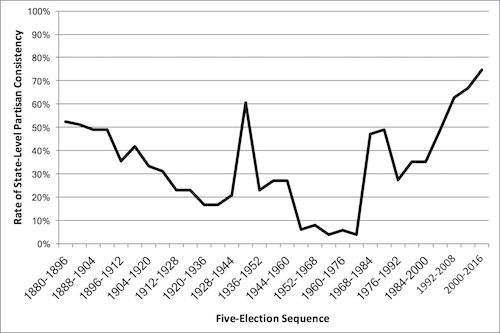
But the complete picture of the emerging electoral map in 2020 reveals far more continuity than change. The current era of presidential elections is distinguished by a historically unmatched degree of consistency in state-level partisan alignments, as depicted in this chart from my book Red Fighting Blue: How Geography and Electoral Rules Polarize American Politics:


Of the 37 states (plus the District of Columbia) that voted for the same party's nominees in each of the five presidential elections between 2000 and 2016, Arizona, Georgia, and Texas seem to be the only plausible candidates to break their streak in 2020—unless the next few months turn so dramatically in Donald Trump's favor that he manages to carry Minnesota or Maine. But even the potential addition of new Sun Belt territory to the familiar Midwest-centered battleground state map doesn't mean that there has been a significant partisan realignment of the South or Southwest over the past four years. What the close recent polls in these states really indicate is not that Trump has developed an unusual regional weakness, but rather that Biden now has a national lead strong enough to pull a few Republican-leaning states into the "competitive" category.

If we compare the two-party popular vote outcome in 2016 with today's two-party polling margin as estimated by The Economist's daily forecasting model for the 16 states where both parties received at least 45 percent of the vote in the last election, we see (after accounting for sampling error and variations in data quality) what looks like a fairly uniform pro-Democratic shift nationwide:

New MexicoClinton +9Biden +13Change: +4 D
VirginiaClinton +6Biden +11Change: +5 D
ColoradoClinton +5Biden +14Change: +9 D
MaineClinton +3Biden +10Change: +7 D
NevadaClinton +3Biden +7Change: +4 D
MinnesotaClinton +2Biden +9Change: +7 D
New HampshireClinton +0Biden +6Change: +6 D
MichiganTrump +0Biden +8Change: +8 D
PennsylvaniaTrump +1Biden +5Change: +6 D
WisconsinTrump +1Biden +6Change: +7 D
FloridaTrump +1Biden +4Change: +5 D
ArizonaTrump +4Biden +3Change: +7 D
North CarolinaTrump +4Biden +2Change: +6 D
GeorgiaTrump +5Trump +0Change: +5 D
OhioTrump +9Biden +1Change: +10 D
TexasTrump +9Trump +3Change: +6 D
IowaTrump +10Trump +2Change: +8 D
NATIONALClinton +2Biden +8Change: +6 D


Polling estimates are, of course, inexact, and all three of the new Sun Belt battlegrounds had already swum against the national tide by becoming "bluer" between 2012 and 2016. But the best recent evidence indicates that these states remain more Republican than the national average, and are currently competitive mostly because Biden is well ahead in the overall popular vote. Even so, Biden appears to have a consistent lead only in Arizona, and he still trails Trump in Texas.

If Biden's current advantage is changing the electoral map in some ways, it's working against change in others. After Trump won Ohio and Iowa by unusually wide margins in 2016, some analysts speculated that both states would lose battleground status in 2020, conceded to the GOP from the start of the campaign. Ohio and Iowa remain clearly Republican-leaning in 2020 compared to the nation as a whole, but Biden's overall lead allows him to keep both states in play (at least for now), and the Trump campaign is indeed spending money to defend them.

A scenario in which Biden maintains or expands his current margin would allow Democrats to consider deploying campaign resources into these states in pursuit of a decisive national victory and gains in downballot offices. But if the race starts to tighten, diverting attention to red-leaning states will be considerably less appealing, and Democratic dreams of "expanding the map" will need to wait for a future contest. Either way, the electoral college outcome in 2020 is still likely to pivot on the four states that Trump carried by narrow margins in 2016: Michigan, Pennsylvania, Wisconsin, and Florida. And there's nothing new at all about those particular states deciding who the next president will be.

Sunday, October 21, 2018

Why the 2018 Election Won't "All Come Down to Turnout"

The claim that an upcoming election "all comes down to turnout" is one of the most venerable clichés in American punditry. But it's become more popular than ever in an era when the mass public is commonly characterized as consisting of two implacable partisan tribes, equally unshakable in their preferences and aversions. If virtually every potential voter is a loyal member of either the red team or the blue team, the outcome of a national election is presumably determined simply by which party can motivate its supporters to participate at the highest rate.

Swing voters are indeed less numerous than they used to be, and the geographic polarization of the American electorate has reduced the number of states and congressional districts that are politically competitive in any given contest. But at a time when the two major parties are closely matched in national strength, the voters who remain open to persuasion continue to hold a lot of electoral power. And it's far from clear whether there will be a large enough difference in the participation rates of committed Democrats and Republicans for turnout to be the primary factor deciding the 2018 election.

To be sure, evidence is piling up that Democratic voters are unusually mobilized this year compared to the recent past. A September survey by the Pew Research Center found that 67 percent of Democratic supporters reported being "more enthusiastic than usual" about voting—a much higher rate than Pew found in either 2014 (36 percent) or 2010 (42 percent). Turnout in Democratic primary elections surged to 23 million voters in 2018, up from 14 million in 2014. And the astounding fundraising totals reported by Democratic congressional candidates, fueled by an unprecedented explosion of small-dollar contributions by individual donors, surely reflects an unusual degree of engagement among politically attentive Democratic citizens—and also ensures a series of generously-funded Democratic get-out-the-vote operations from one end of the country to the other.

But 2010 and 2014 were both unusually poor elections for the Democratic Party nationwide. Improved Democratic participation in 2018 compared to the two most recent midterms may prevent another disastrous performance, but it hardly guarantees a blue wave. And while Democrats are clearly much more engaged this year than in the recent past, Republicans are not necessarily less engaged.

According to Pew, 59 percent of Republican supporters are "more enthusiastic" about voting than usual in 2018—not far behind Democrats and at least equal to Republicans' own reported enthusiasm levels in 2014 (52 percent) and 2010 (57 percent). Among respondents to a recent Washington Post poll, 81 percent of Democrats and 79 percent of Republicans claimed to be "absolutely certain to vote" in November (surely a massive collective exaggeration of the actual turnout rate, but not one that reveals a significant difference between the parties), and an NBC-Wall Street Journal survey found that 72 percent of Democrats and 68 percent of Republicans reported "high interest" in the 2018 elections. Similarly, while the GOP didn't experience a spike in participation as large as that of the Democrats this year, turnout in Republican primaries was still higher in 2018 than 2014, growing from 15.5 million to more than 19 million votes.

Moreover, few pollsters are finding that restricting their analyses to the fraction of respondents identified as certain or likely voters (as opposed to all registered voters) produces significantly more favorable results for Democratic candidates in 2018. In fact, it's relatively good news for Democrats that they don't seem to lose ground when survey analysts use a "likely voter screen" to compensate for the projected composition of this year's electorate. Republicans normally enjoy a persistently higher turnout rate in midterm elections that diminishes or disappears in good Democratic years but seldom, if ever, transforms into an actual pro-Democratic turnout advantage. As Nate Cohn of the New York Times observes, "When Democrats hold the presidency, Republicans generally have a big midterm turnout edge . . . [and] when Republicans hold the presidency, Democrats fight back to parity."

Based on the incomplete signs so far from state election officials' reported early voting and absentee balloting totals, turnout is likely to increase across the board in 2018 from its 2014 levels. Democrats, of course, are strongly motivated this year by their deep antipathy to the Trump presidency. But Republicans don't appear to be staying home either—certainly not to the degree that Democrats did during the two Obama midterms. The polarizing figure of Trump may be inspiring elevated engagement on both sides; at minimum, it seems likely that the constant public attention commanded by the current president has resulted in Americans of all partisan persuasions thinking and talking more about politics than they did before he took office.

With Democrats and Republicans both invested in this year's election, a potential nationwide blue wave will require a non-trivial proportion of voters to shift from the GOP (or third parties) in 2016 to Democratic candidates in 2018. There are 25 Republican-held House seats that were carried by Hillary Clinton in 2016, barely more than the minimum net gain (23) needed by the Democrats to take control of the chamber, and it seems unlikely that Democrats could win enough of these seats alone to gain an overall majority. But there are also 16 Republican-held seats that Trump carried with less than 50 percent of the total popular vote, 23 additional Republican seats where Trump received between 50 and 52 percent of the total vote, and another 24 seats where Trump received 53 or 54 percent of the vote. These are the pivotal districts that hold the partisan balance of power in the House. Democrats don't need to peel off a large share of voters who previously preferred Republican candidates in order to capture majority control, but merely energizing their own habitual partisan supporters is probably insufficient to flip enough seats their way absent a modicum of successful persuasion as well.

In the Senate, the Democrats' need for a lopsided advantage among swing voters is even more evident. Five of the six most vulnerable Democratic incumbents this fall were elected in 2012 even as Mitt Romney carried their states over Barack Obama (Joe Donnelly of Indiana, Claire McCaskill of Missouri, Jon Tester of Montana, Heidi Heitkamp of North Dakota, and Joe Manchin of West Virginia); the sixth, Bill Nelson of Florida, represents a state where Obama achieved a narrow plurality win. All six states shifted further toward the Republicans in 2016; these Democrats are thus dependent upon a significant share of their constituents continuing to divide their partisan preferences, and this dependence increases further with every sign of a mobilized Republican base in 2018.

According to exit polls, self-identified independents preferred Republican candidates by margins of 56 percent to 44 percent in 2014 and 59 percent to 41 percent in 2010, making an underappreciated but critical contribution to the national GOP sweep in both elections. In 2006—the last Democratic midterm victory—independents gave Democrats an equally favorable margin of 59 percent to 41 percent. Leads for Democratic candidates in 2018 voter surveys, including a persistent advantage for the party in the national generic congressional ballot, have similarly been fueled by a steady erosion of Republican support among independents since the 2016 election. The addition of these independent votes to the revved-up Democratic "resistance" seems like a formula for electoral success in November, but many persuadable voters are not as attentive to politics as strong partisans are, and their preferences are likely to be somewhat unsettled even as Election Day swiftly approaches. With so many seats in play at all levels of government, it's still too soon to tell exactly how far the swing vote will swing.

Wednesday, October 10, 2018

Podcast on Trump's GOP, the Democratic Opposition, and What's Ahead in November (and Beyond)

My colleague and co-author Matt Grossmann hosts an excellent podcast, Political Research Digest, featuring short interviews with social scientists about their latest research. For the first anniversary of the podcast, Matt invited me to join him in a longer and more conversational episode in which we consider how the major differences between the two parties that we identified in our book Asymmetric Politics: Ideological Republicans and Group Interest Democrats have or haven't changed in the two years since the book's publication. We also discuss the 2018 elections, the future of the Democratic Party in 2019 and 2020, and my latest book Red Fighting Blue: How Geography and Electoral Rules Polarize American Politics. You can listen to our conversation and/or read a transcript here.

Wednesday, August 15, 2018

A Few Political Consequences of the Democratic Surge Among College-Educated Whites

The Pew Research Center recently released an informative report on the composition of the American electorate, based on a survey of citizens whose electoral participation (or lack thereof) in 2016 was confirmed by matching their names to state voter turnout records. High-quality studies like those conducted by Pew provide more reliable information on the distribution of attributes within the voting public than the more commonly-cited (but less methodologically sound) national exit polls, and thus any discrepancies between them are usually best resolved in favor of the former.

For example, exit polls can overestimate the degree of educational attainment in the electorate. In 2016, the national exit poll found, improbably, that a full 50 percent of voters had earned at least a bachelor's degree, with just 18 percent reporting no more than a high school education. The new Pew study estimates that the true figures are the following: 37 percent with a BA degree or more, 34 percent with college experience short of a four-year degree, and 30 percent with a high school diploma or less—much closer to a rough three-way split among the no, some, and completed college categories than an even divide between four-year college graduates and non-grads.

But if the true proportion of college graduates in the voting public was smaller than the exit polls indicated, these voters also seem to have preferred Hillary Clinton to Donald Trump much more decisively than the exit pollsters believed. The national exit poll estimated that Clinton had prevailed over Trump by 52 percent to 42 percent among all four-year college graduates, narrowly losing white college grads by a margin of 48 percent to 45 percent and carrying white female grads by 7 points (51 percent to 44 percent). According to the Pew researchers, however, Clinton outpolled Trump by a full 21 points (57 percent to 36 percent) among all college graduates, by 17 points (55 percent to 38 percent) among white grads, and by 26 points (61 percent to 35 percent) among white female grads.

The Pew figures aren't likely to be precisely correct; sampling error and other methodological limitations apply to them as well. But they surely come closer than the exit poll data to the true values within the American population. Since pre-election surveys and other forms of evidence indicate that Trump carried non-college-grad whites overwhelmingly (perhaps by as much as 40 points), the most logical way to account for the fact that Clinton outran Trump by 2.8 million popular votes nationwide is to assume that she prevailed among the college/post-grad sector of the electorate by a comfortable margin. In fact, Clinton is almost certainly the first Democratic presidential candidate in modern history to win more votes from white college graduates than the Republican opposition.

This achievement undoubtedly reflects the limits of Trump's appeal among college-educated voters more than any special devotion to Clinton. But the Democratic Party was evolving even before 2016 to become more dependent on the votes of racial minorities, young adults, and highly-educated professionals (the "Obama coalition") while relinquishing much of its previous electoral support among non-college-educated whites to the GOP. Moreover, recent opinion polls and the results of special elections indicate that the pro-Democratic shift among white college graduates evident in the 2016 contest has survived into 2017 and 2018, suggesting that the Democratic leanings of these voters will endure for at least as long as Trump is the leader of the Republican Party.

What are the implications of a newfound preference for Democrats within this formerly majority-Republican sector of the electorate? Here are a few areas of American politics that will be measurably affected by such a change:

1. Geography. Because educational attainment is not evenly distributed across geographic boundaries, the places where each party can expect to win votes will evolve along with the demographic composition of their voter coalitions. In general, we can expect the growing partisan divide between increasingly "blue" large metropolitan areas and securely "red" small towns, a trend explored in my recent book Red Fighting Blue: How Geography and Electoral Rules Polarize American Politics, to persist into the future. This will help Democratic candidates in high-education suburbs where a number of vulnerable Republican-held House seats are located, such as those actively contested this year in greater New York, Philadelphia, Washington, Chicago, Denver, Seattle, and Los Angeles. But most of these places already vote Democratic at the state level, while the erosion of Democratic support among non-college whites endangers the party's Senate prospects in states like Indiana, Missouri, and North Dakota. As a result, it's quite possible that the midterm elections this year will result in a majority-making Democratic "wave" of 25 seats or more in the House while simultaneously preserving, or even strengthening, Republican control of the Senate.

2. Participation. Level of educational attainment is always a powerful predictor, and often the most powerful predictor, of citizens' propensity for political engagement. Participatory activities that go beyond merely voting for president every four years—from turning out in midterm and primary elections to volunteering for campaigns, making monetary contributions, and organizing political events and groups—are all disproportionately the domain of the highly-educated. Democrats already appear to be benefiting this year from the energetic mobilization of metropolitan professionals, which has led to both a rise of political networking at the local level and a cascade of individual financial donations to Democratic candidates. In contrast, one of the biggest unanswered questions as we look forward to the 2018 midterms is whether the Republican Party will succeed in motivating the non-college-grad whites who supported Trump in heavy numbers two years ago to turn out at sufficient rates in a non-presidential election when Trump himself is not on the ballot.

3. Candidate Recruitment. Whites with college degrees are a minority of the total electorate, but they always constitute a large majority of the pool of candidates for federal and state office. A partisan shift among this population therefore influences the relative supply of strong candidates within each party's activist base. The particular antipathy to Trump evident among college-educated women in the Pew data helps to account for an unprecedented spike in the number of female candidates on the Democratic side in 2018, and the desire to send a message of opposition to Trump's behavior seems to have inspired Democratic primary voters to frequently choose these women to be standard-bearers for the party. Through the first 41 states to hold primaries so far this year, 41 percent of all Democratic House nominees this year are women, including 48 percent of all non-incumbent nominees—an astonishing increase over all previous congressional elections:


4. The Polarization of Education Policy. Education has not always been a strictly partisan or ideologically-charged issue. Past Republican presidents like George W. Bush adopted ambitious education initiatives in order to bolster their appeal among suburban moderates, while state governors and legislators of both parties have often viewed the authorization of ample K-12 and public university funding as both economically and politically advantageous. But there are signs that this bipartisan consensus is coming apart. In recent years, Republican governors in Kansas and Oklahoma have enacted ambitious tax reductions that required deep offsetting decreases to local education aid, while GOP legislators in Wisconsin have targeted state universities for budget cuts and other restrictions. In addition, conservative media sources now repeatedly direct sharp criticism at the American educational system, often describing universities as bastions of intolerant leftism and mocking college students as hopelessly coddled "snowflakes."

If highly-educated voters continue to drift toward the Democrats, a key constituency that might be expected to serve as an internal base of resistance against these policies will lose its current degree of influence within the Republican Party—which may well only further reinforce the trend of growing polarization. Trump has not made education a presidential priority, and his appointment of the controversial Betsy DeVos as secretary of education has done little to bolster his popular standing on the issue. But while Republicans may pay an electoral price in the short term due to the countermobilization of concerned parents and outraged teachers, the prospect of a perpetual partisan war over the value of American education ultimately threatens the interests of educators much more than those of politicians.
Monday, July 30, 2018

Was the Midwestern "Red Shift" More Pro-Trump or Anti-Hillary? The Answer Matters a Lot for 2018

The election analyst Nate Cohn of the New York Times published an excellent piece today arguing that the Democrats are benefiting from an electoral battleground in 2018 that is broader than was anticipated by the post-2016 conventional wisdom. In particular, he notes, Democratic candidates appear to be doing better than expected this year in heavily white, lower-education congressional districts that voted for Donald Trump. This has allowed the party to contest many more seats than it would if the scope of electoral competition were restricted to the smaller number of Republican-held well-educated suburban districts that had shifted toward Hillary Clinton in 2016.

In general, one of the most challenging aspects of analyzing events in real time is distinguishing temporary blips from more durable trends. Popular pundits and other media figures often tend to overstate the degree to which immediate events portend long-term patterns; as I noted once in another context, "There's a temptation to assume that everything new in politics is a harbinger of the future. But lots of things are dead ends: They rise, and they go away." On the other hand, we academics are often prone to the opposite bias, hanging onto familiar theories and assumptions past the point when evidence has built up that the world has indeed changed.

When it comes to the geographic polarization of American voters, there's an unmistakable decades-long trend of divergence between (pro-Democratic) metropolitan areas and (increasingly Republican) rural areas, but also an especially sharp and unprecedented increase in this gap in the 2016 presidential election—as illustrated in this summary of partisan voting in the pivotal Midwest region taken from Chapter 6 of my book Red Fighting Blue: How Geography and Electoral Rules Polarize American Politics:


The rural Midwest has been trending Republican for a long time; Bill Clinton narrowly carried it twice in the 1990s, but Barack Obama lost this vote 53 percent to 47 percent in 2008 and 57 to 43 in 2012. In 2016, Donald Trump routed Hillary Clinton here, attracting 68 percent of the two-party rural Midwestern vote—6 points better than Ronald Reagan in his 49-state landslide 1984 reelection.

If 2016 indeed represents the "new normal," than it would make sense for analysts to take a bearish view of Democratic chances in white, small-town congressional districts in the Midwest and elsewhere this year. But if 2016 was something of an aberration, and the Trump-Clinton vote does not fully reflect the relative fundamental strength of the two parties, then the map of electoral battlegrounds opens wider, and the fortunes of congressional Democrats improve accordingly.

Midterm elections are always primarily a referendum on the president, and Trump has dominated the political scene so thoroughly since he took office that this rule of thumb is likely to be especially applicable to 2018. If the remarkable Republican strength in the rural Midwest in 2016 was primarily a reflection of Trump's personal popularity, we might expect it to carry over into 2018 unless a significant share of formerly-enthusiastic Trump supporters had become disillusioned in the interim. But if the abrupt partisan shift between 2012 and 2016 visible in the figure above was largely a reflection of Hillary Clinton's personal unpopularity with rural Midwesterners—as well as a Clinton campaign that eschewed economic issues to an unprecedented degree for a modern Democrat—we shouldn't be surprised by a significant Democratic rebound in the region this November, since Clinton will be neither on the ballot nor in the White House.

Cohn's piece focuses exclusively on the House of Representatives, but the question of whether the 2016 "red shift" across the north-central section of the country is a temporary or enduring development becomes even more critical when we turn to the Senate—where Democrats are defending nine seats in Trump-carried states stretching from Pennsylvania to Montana plus two more in Minnesota (which Trump lost by less than two points). Using the 2016 presidential results as a starting point for expectations of 2018 outcomes paints a very optimistic picture for Republicans; Trump carried Indiana, Missouri, and Montana by about 20 points and won North Dakota and West Virginia by more than 35. Yet all of these states elected Democratic senators only six years ago, and all of them but North Dakota were actively contested at the presidential level as recently as 2004 or 2008. 

Many loyal Democrats will not easily accept the belief that the results in 2016 reflected a widespread popular antipathy to Hillary Clinton. And the surprising nature of Trump's victory has encouraged the view, even among his fiercest critics, that he maintains under-appreciated political strengths. But the more validity to the conclusion that Trump was a weak candidate who won a close and fluky election only because he was facing a seriously flawed opponent, the rosier the outlook becomes for Democrats this November.

Wednesday, December 27, 2017

Corporations and the Culture War: Op-Ed in the New York Times

I have a new op-ed piece in the New York Times explaining how the culture war has fueled geographic divisions in the American electorate, which in turn has ended up furthering the interests of wealthy individuals and corporations. The analysis draws on the research presented in my recent book Red Fighting Blue: How Geography and Electoral Rules Polarize American Politics.

Tuesday, October 24, 2017

In Today's America, Small Voting Shifts Can Have Really Big Effects

My new book Red Fighting Blue: How Geography and Electoral Rules Polarize American Politics demonstrates that American elections have become more geographically polarized over the past 25 years and investigates the causes and consequences of this important development. I argue that it's very difficult to understand how politics operates today without recognizing the ways in which the spatial distribution of party votes across geographic lines interacts with the rules and mechanisms of our electoral institutions to produce representative democracy in the United States.

One of the most distinctive attributes of our current political era is that the two parties are closely balanced at the national level, yet each side maintains a formidable record of electoral dominance across large regional subsections of the United States. Since the 1990s, we have experienced a series of elections in which the overall outcome has been decided by a narrow margin even as most states and congressional districts are securely and reliably either Republican or Democratic. While it was once common for most states—and nearly all large states—to be electorally up for grabs and thus actively contested by both sides in a national campaign, the number of "battleground" states has dwindled in the 21st century to a small minority of the nation:


At the same time, the election-to-election stability of these state alignments has reached historically unmatched levels. It's not just the case that most states in any given year will be safely pro-Democratic or pro-Republican while a shrinking remainder of states will be open to contestation—instead, it's increasingly the same states that are predictably "red" or "blue" in election after election,  and the same few swing states, like Ohio, Florida, and Michigan, that hold the national balance of power from one election to the next. Over the past five presidential elections, 37 states and the District of Columbia have aligned with the same party in each contest; as the graph below shows, this represents a record degree of state-level consistency. We're a long way from the presidential elections of 1956 and 1964, when all but five states in the nation voted for opposite parties in two races held just eight years apart.


Because of the winner-take-all American electoral system, these trends mean that partisan shifts among a relatively small subset of voters in a relatively small section of the nation can have a tremendous effect on outcomes if they happen to be concentrated in exactly the right place. My political science colleague Seth Masket wrote today in Vox about the changing partisan preferences among non-college-educated whites in the small-town Midwest that proved electorally pivotal in 2016, delivering the White House to Donald Trump despite his loss in the national popular vote (see my own graph below as well). Seth concludes, I think persuasively, that these shifts are not broad enough to add up to a party "realignment"—but they still proved to be decisive because they occurred in a few key states that were otherwise closely divided between the parties. Hillary Clinton ran particularly well among college-educated whites and racial minorities in 2016, which helped her outperform previous Democratic candidates in non-battleground states like California, Texas, and Arizona but didn't pay her any dividends in the unique arithmetic of the electoral college.

The Geographic Polarization of the Midwest, 1980–2016


Because the leadership of the two parties is as mutually polarized and otherwise differentiated as at any time in modern history, the consequences of these electoral outcomes for the trajectory of national politics are increasingly significant even as the outcomes themselves are more and more likely to be contingent on the attributes, and eccentricities, of the electoral system itself. Historically speaking, there wasn't much of a difference between how Americans voted in 2012 and how they voted in 2016. But there's an awfully big difference between President Barack Obama and President Donald Trump.

Thursday, October 19, 2017

New Book: Red Fighting Blue

I'm very happy to announce that my new book, Red Fighting Blue: How Geography and Electoral Rules Polarize American Politics, has just been published by Cambridge University Press in paperback, hardcover, and eBook formats.

The book explains how the emergence of significant and persistent regional differences in partisan voting patterns in both presidential and congressional elections since the 1990s has had a profound effect on party politics in the United States. The American electoral system, with its geographically-defined voting constituencies and winner-take-all rules, has greatly magnified these differences when translating the preferences of citizens into electoral college outcomes and the partisan and ideological composition of Congress. The moderate Democrats formerly elected in large numbers from what are now the "red" states and the moderate Republicans who once represented the "blue" states are both disappearing from office, leaving increasingly polarized parties and an ever-shrinking scope of electoral competition. In an age in which the two major parties are closely balanced but each increasingly dominant across large regional subsections of the nation, the specific ways in which the geographic distribution of party support interacts with the rules of the American electoral process accounts for how our politics works—or doesn't work—in the 21st century.