Thursday, October 29, 2020
The Reappearing American Voter
Friday, October 23, 2020
Second Presidential Debate Recap: At Long Last, a Conventional Partisan Fight
Wednesday, October 14, 2020
Five Years of Graft
I started Honest Graft with the self-justification that it would be worthwhile even if almost nobody read the posts. For one thing, I often find that writing about a subject helps me figure out what I think about it. Developing a habit of posting regularly about current events more or less as they occurred would compel me to form a point of view on what was going on. I reasoned that this might help me understand politics better, might spark ideas for research, or at least might leave me an electronic paper trail of contemporary analysis that might be useful later on for recalling what important political moments felt like at the time.
In the fall of 2015, I was also an assistant professor with two book projects in progress but no publishing contracts in hand and no certainty of receiving tenure. Practicing my non-academic thinking and writing skills seemed like a prudent use of my limited spare time, in case my academic career didn't work out and I needed to find another job.
Happily, my professional luck improved soon afterwards. Matt Grossmann and I placed Asymmetric Politics with Oxford University Press that December, and the following spring Cambridge University Press mercifully rescued Red Fighting Blue from indefinite purgatory at another publisher. But I kept the blog going even after my promotion: it was rewarding to do, plus American politics had entered an unusually eventful phase that generated a constant stream of fodder for contemplation.
Blogging is much less fashionable than it used to be, and that's a shame. The social media platforms that have mostly supplanted it are an inferior replacement in many respects except the ability to trade quick interactions with friends in other places. Social media too often encourages hit-and-run hot takes or cheap shots at the expense of developing a nuanced line of thought, it rewards trite pandering to partisan or ideological claques, and it has fostered a distinctively adolescent prevailing culture of behavior that is alienating to anyone who prefers a drier, less dramatic style of expression. As its consciously retro and amateurish visual design scheme symbolizes, Honest Graft is a bit of a throwback, but it's still been a lot of fun. I would recommend blogging to anyone who's considered it—especially academics looking for a way to apply their knowledge and skills to topics of contemporary interest.
Honest Graft has introduced me to many people whom I might never have otherwise gotten the chance to meet. Thank you to everyone who's been a regular or occasional reader, shared a post with friends or followers, or passed along a response or a compliment. I appreciate it all, and you've made the blog a very unexpected success. While too many people to name have been extraordinarily supportive over the years, I want to take the occasion of this anniversary to express my gratitude to two great friends of Honest Graft.
The first is John Sides, the co-founder of the Monkey Cage and a professor at Vanderbilt University. John has been a patron of HG from its inception, reprinting some early posts at the Monkey Cage when I was still new to blogging. The Monkey Cage has stood for years as a monument to the value of public engagement, giving specialist scholars a platform to share their expertise with wider audiences to mutual benefit, and both it and John's own scholarship and analysis have set an exemplary standard for those of us who follow.
Monday, October 12, 2020
The New Electoral Map Isn't Very New, But Biden's Lead Keeps the Battleground From Shrinking
We're now in the home stretch of the 2020 presidential campaign, with millions of ballots already cast via early and mail-in voting. The two candidates and their advisors are now making final decisions about where to allocate resources—ad spending, voter mobilization operations, and travel by the nominees and their running mates, spouses‚ and top surrogates—based on their current appraisals of optimal electoral college strategy.
Donald Trump and Hillary Clinton actively contested 14 states between them in 2016, collectively casting 32 percent of the nation's electoral votes. In the wake of the last election, however, most analysts expected the geographic scope of electoral competition to shrink in 2020. Trump's comfortable victories in Ohio (by 8 percentage points) and Iowa (by more than 9), along with his unexpected strength across the rest of the Midwest, seemed to signal that these two perennial battleground states were no longer pivotal and might be justifiably conceded to the Republicans in the future, while the pro-Democratic shift evident in sections of the Sun Belt from 2012 to 2016 wasn't clearly strong enough yet to push traditionally "red" bastions like Georgia and Texas into legitimate partisan competitiveness.
These expectations were all perfectly reasonable extrapolations from the 2016 results. But they rested on assumptions of another tight contest in 2020, rather than the clear and consistent Democratic lead—now flirting with double digits in the national popular vote—that actually emerged. Joe Biden's overall advantage has allowed him to remain viable in Ohio and Iowa despite their recent Republican leanings while also mounting an incursion into Georgia and Texas, both uncontested by Democratic presidential candidates since the 1990s. The only two states to drop out of the battleground category between 2016 and 2020 were Virginia and Colorado, both already swiftly moving in a Democratic direction but put altogether out of reach for the Republicans by a poor national climate for the party this year.
Contrary to previous suggestions of a shrinking battleground map, then, the presidential campaigns are once again contesting 14 states in 2020 (plus the single electoral vote awarded to the winner of Nebraska's 2nd congressional district). The replacement of Virginia and Colorado with the more populous states of Texas and Georgia means that the candidates are actually fighting over more presidential electors than last time—in fact, as the figure below demonstrates, the battleground this year is the largest in terms of electoral votes since the 2000 election:
Wednesday, October 07, 2020
Vice Presidential Debate Recap: Nothing Interesting Happened...Thankfully
The vice presidential debate Wednesday night between Mike Pence and Kamala Harris was such a crucial ritual of American democracy—so precious to our electoral process that it had to be held in person despite an active national epidemic—that many leading figures in American journalism found their attention repeatedly distracted by a fly that landed on Pence's head partway through the evening.
Both participants are classic pols with well-crafted classic pol personas that don't compel them to answer questions they don't find it advisable to answer, and the vice presidential debate is always a slightly unnatural format because it mostly involves attacking or defending two other people who aren't in the room. The relative discipline and polish of both Pence and Harris compared to this year's presidential nominees makes it easier for the strategic calculations of both campaigns to come through: Democrats want the election to turn on COVID-19 and health care, while Republicans would rather talk about China and the Green New Deal.
The lower rhetorical temperature compared to last week's presidential faceoff was nominally praised by commentators, but the consensus media judgment that "no minds would be changed" as a result, as well as the fixation on the fly, betrayed a certain general boredom with the proceedings. But because debates are a lousy basis on which to choose a candidate—especially vice presidential debates—this was actually a good sign. There's really nothing wrong with a boring debate, after all. There are worse things in politics than prosaic adequacy.
Wednesday, September 30, 2020
First Presidential Debate Recap: What Was Said Is Still More Important Than How It Was Said
As a long-confirmed debate skeptic who was thoroughly unsurprised by what happened Tuesday night, I must admit to feeling a bit amused by the theatrically offended responses of major media personalities, whose (normally ample) faith in the civic value of debates was suddenly shaken to the point of wondering whether there would, or should, be a second or third event this year. Nothing that President Trump did or said was any different from what he has done or said in countless press conferences, interviews, and Twitter communications since he became a political figure. But for some reason this thoroughly characteristic behavior is deemed to be a more serious threat to the health of the polity when it occurs on the sacred debate stage than in any other public forum.
I, too, would welcome a calmer and more respectful exchange of ideas conducted with scrupulous adherence to the mutually negotiated ground rules. In the end, though, it's a mistake to focus too much on issues of personal demeanor at the expense of rhetorical substance—how something was said, rather than what was said. Who interrupted whom is not terribly important at a time when the nation is facing multiple simultaneous crises, and when the legitimacy of the election itself is among the topics openly contested by the candidates.
There was a time when Trump was treated as the most fascinatingly spontaneous figure in politics. Compared to other politicians, he certainly seemed that way at first—all the ad libs and digressions and heterodoxies and he-didn't-just-say-that-did-he transgressiveness made him stand out from the scripted, handled pack. But after years and years of the same approach, same arguments, and same obsessions, he's actually become remarkably predictable; the bag of tricks has turned out to be smaller than it looked. Other presidents who have suffered poorly-received debate performances have shown the ability to learn, to adapt, to change their strategic course. But there's little reason to expect anything but more of the same in the next two debates, which leaves the Trump campaign mostly where it was before tonight: hoping that their current opponent somehow becomes just as divisive as their last one.
Monday, September 28, 2020
If We Must Have Debates, Let's at Least Make Them Smarter
The closest that this blog comes to a pose of assertive contrarianism is its consistently dismissive attitude toward the staging of televised debates in presidential campaigns. Debates are a well-established quadrennial tradition that are often treated as sacred rites of civic virtue; self-righteous outrage predictably ensues upon any suggestion that a candidate might or should refuse to participate. The political world is filled with people who are invested in puffing up debates, many of whom were no doubt captains of their high school debate teams. But there's a pretty strong case that their actual value to the democratic process is often zero and sometimes negative.
There are two main problems with debates. First, they are framed in advance as valuable exercises in political deliberation and public edification even though they are actually treated as a form of entertainment and as one more arena of partisan competition. Second, the media commentators whose interpretations affect public perceptions of the outcome often decide who "won" and who "lost" on fairly silly grounds. Cracking a pre-written joke, sighing into a microphone, having too much on-camera energy or not enough—are these really the moments upon which the leadership of the nation should properly turn?
If debates are here to stay, which they are at least until a future candidate is bold enough to boycott them, they could at least be smartened up a bit. Here are three specific areas that could badly use improvement:
1. Before the debates: ignore campaign spin.
Maybe Trump didn't play the spin game well. So what? There's no good reason why independent observers' judgments about debate performance should be shaped by whatever the nominees or their flacks say beforehand. (And note the recent Washington Post story quoting anonymous Democratic sources trying to lower expectations in their own way by claiming to worry about Biden losing his temper in response to Trump's provocations.) The excessive importance of prior "expectations" means that debate participants are often not compared with each other, but are judged instead against the caricatures of themselves that already exist in the minds of media analysts. Indeed, if Trump were simply to behave 30 percent less combatively than normal tomorrow night, he would earn some of the best press coverage of his entire presidency even if his performance were otherwise unmemorable.
2. During the debates: ask questions designed to illuminate important subjects for voters, not just play gotcha with candidates.
Debate moderators sometimes fall into the practice of choosing what they think of as "tough" questions: questions that try to catch a candidate in some kind of exaggeration or hypocrisy, or that effectively restate whatever attacks the opposition is making at the time. There is a place for such questions. But they seldom produce interesting responses, in part because candidates anticipate them and rehearse a deflection, and the debate can easily become stuck on a topic that doesn't ultimately have much to do with the job the participants are seeking.
Intended "gotcha" questions should be better balanced with more open-ended, less overtly antagonistic questions that invite candidates to envision the future as well as defend their past, and that focus as much as possible on the presidency's actual powers—which are more expansive in the realms of foreign policy and public administration than in the well-trod ground of legislator-in-chief—as well as its limitations. If debates are to be a kind of public job interview in which the audience actually learns something about the applicants that is relevant to their potential future responsibilities, the questions need to reflect what the job actually is. And any "fun" or "unconventional" question—"what do you do to relax?" or "can you say something nice about your opponent?"—is always an insulting waste of time, a smarmy condescension to Middle America in the guise of artificial folksiness. (Whenever regular citizens have the opportunity to address presidential candidates, they nearly always ask questions that are serious and policy-focused.)
3. After the debates: coverage should focus on what was said, not how it was said.
The history of debates is strewn with supposed candidate gaffes, but very few of those identified by media critics involve truly troubling mistakes—the misstatement of an important fact, the outright smear of an opponent, an insensitive remark directed towards a social group. From Richard Nixon's physical appearance to Mitt Romney's inelegantly-phrased description of his governorship's female staff recruitment efforts, nearly all of the best-remembered debate "blunders" over the years remain firmly at the who-really-cares level of substantive importance. Even the ability of a candidate to recover from a "bad" performance in one debate with a "good" showing a week or two later, as Ronald Reagan, George W. Bush, and Barack Obama all did in their re-election campaigns, merely proves how unreliable it can be to judge potential presidents based on their personal demeanor in any particular circumstance. Besides, we already know plenty about what kinds of people these candidates are. Let's focus on what they say they will do.
Wednesday, September 16, 2020
2020 Has Quietly Become Another "Year of the Woman"
The entire House of Representatives and one-third of the Senate are up for election every two years. But congressional elections tend to lead the news only every other cycle, when there isn't a concurrent presidential contest. James Madison may have believed that the "legislative authority necessarily predominates" over the executive, but most Americans don't seem to behave accordingly; a development or trend in congressional politics that would be treated like a big deal in a midterm year will always receive much less attention if it happens to coincide with the selection of the president.
In 2018, the leading story of the congressional midterms was the anti-Trump backlash that handed control of the House of Representatives to the opposition Democrats. The "resistance movement" widely credited with fueling the Democratic victory was distinctively female in its complexion—not only among voters and activists but also at the level of the candidates themselves. A record number of women sought public office in 2018, and a record number were elected to Congress.
Though it hasn't received the same degree of notice this time around, the records broken in 2018 will be broken again this year. With yesterday's Delaware primary election marking the end of the congressional nomination season, the numbers are now available to make full historical comparisons. Among Democrats, 48 percent of all House nominees in 2020 are women, exceeding the all-time high of 42 percent set in 2018. And for the first time in history, a majority (58 percent) of non-incumbent Democratic nominees are women.
An even bigger change has happened on the Republican side this year. The mobilization of women was a single-party phenomenon last election, but now it's become bipartisan. The share of female Republican House nominees grew from 13 percent to 23 percent between 2018 and 2020, and the share of women among non-incumbent nominees surged from 18 percent to 33 percent—not only easily outpacing any previous election for Republicans, but even exceeding the Democratic rate in every year before 2018.
Monday, September 14, 2020
If Trump Has Money Problems, They Won't Matter Much
These articles all adopt a "WARNING: Crisis in Progress" tone that runs a bit ahead of the specific facts provided. A careful reading of the evidence reveals that the Trump campaign is far from broke (in fact, Trump raised $200 million in August, a historically staggering sum). What's really happened is that Trump's anticipated financial advantage has disappeared because Trump spent a chunk of money early in the race that is naturally unavailable to him now, and because his opponent has found even greater recent fundraising success (Biden raised over $350 million in August, a historically staggering-until-you-fall-over sum).
It's true enough that Biden is currently outspending Trump on swing-state television. But these reports also suggest that Trump's newly-installed campaign manager Bill Stepien has made the strategic decision to save money for a final barrage later in the race. Perhaps this choice is somewhat born of necessity; if the Trump campaign had no realistic limits on its financial resources, it would presumably be matching Biden right now. However, that doesn't mean the strategy will fail. Trump had an overall financial disadvantage in his 2016 race against Hillary Clinton, but his campaign actually outspent hers on television ads from mid-October onward and received considerable last-minute help as well from Republican-aligned super PACs.
The articles are also peppered with examples of supposedly wasteful expenditures by the Trump campaign. But $150,000 for airplane-towed aerial banners or $100,000 for cell phone security containers, whatever their usefulness or lack thereof, are petty cash-level sums in an operation on track to raise and spend well over a billion dollars in total. These factoids must be viewed within a particular context: there has been a change in leadership within the campaign, and the current Stepien-led regime has every reason to plant unflattering tidbits in the press about the decisions made during the tenure of predecessor Brad Parscale. If Trump makes a comeback in the final weeks, Stepien and company will gladly take credit for turning around the ship; if Trump loses, they will be happy enough to suggest that Parscale left them an unsalvageable wreck.
Even if Trump does face a financial disadvantage from now until November, this is very unlikely to be an election decided by money—especially his money. Most Americans' opinions about the incumbent, whether pro or con, are so strongly held that they will be very resistant to being swayed by advertising, and ad messages must compete with news media coverage to serve as information sources for the remaining bloc of undecided voters. Though he is being outgunned on the airwaves at the moment, Trump has already spent a lot this year on ads in both the television and digital realms, and these efforts didn't seem to exert a measurable effect on the horse race. The main Republican lines of attack since Biden became the apparent Democratic nominee in March haven't significantly damaged Biden's vote share or personal favorability rating, so it's not clear that putting more ad dollars behind the same message would make much of a difference.
Campaigns running consistently behind in the polls are always subjected to press coverage portraying them as organizationally incompetent, just as the strategists behind victorious candidates are always celebrated as political geniuses. Four years ago, media story after media story chronicled the chaotic, amateur-hour nature of the sure-loser Trump campaign (in contrast to the confident, professional Clinton operation) up until late in the evening on the night of the election, when commentators suddenly discovered that the Trump crew had been smarter and savvier than the Clinton team all along. It's obvious enough that Trump's second presidential campaign, like his first, has squandered advantages and misallocated resources. But elections are rarely decided by these factors, and it's hard to make the case that any significant share of voters won't have become very familiar with Donald Trump's campaign message by the time they cast their ballots.
Thursday, August 27, 2020
2020 Republican National Convention Recap
But the words of these speeches showed how much Trump's consolidation of power within the party has been accompanied by his adoption of its existing ideological commitments. Speaker after speaker at this week's convention reinforced standard Republican themes: small government, social traditionalism, veneration of the military and law enforcement, and attacks on "socialism," the "radical left," and the news media. Even the president's children, who might have been expected to spend their stage time sharing family anecdotes intended to create favorable personal impressions of their father, concentrated instead on delivering familiar conservative rhetoric. The occasional heterodoxies of the 2016 Trump campaign, which convinced many pundits and voters at the time that he was pulling the Republican Party to the left on economic policy, are no longer evident.
If there was something a bit redundant about the Republican convention, beyond the repetitive format forced in part by COVID-related restrictions, it stems from this presidency's unprecedented day-to-day domination of the political world over the past four years and the volume of coverage it already receives in both the mainstream and conservative media. Even enthusiastic supporters already have many other avenues of constant exposure to communication from Trump and his staff, and the campaign chose not to use their candidates' acceptance addresses, or the convention in general, to make much news.
It's hard to remember another presidential campaign in which concrete proposals and potential legislative initiatives have played such a minor role. Democrats have plenty of ideas for policy reform, as usual, but they did not make them the centerpiece of their public message in last week's convention; Biden's acceptance address mostly omitted the traditional "laundry list" of issue-specific domestic appeals in favor of a narrower focus on denouncing Trump as a threat to American values and mismanager of the COVID response. But the Republican convention was even more devoid of a vision for the next four years that centered on the actual powers and responsibilities of the president, as opposed to its frequent expression of emotionally charged but mostly symbolic opposition to the media, national anthem protests, destruction of local statuary, and "cancel culture." In the midst of an ongoing national economic and public health crisis that requires active, competent management to address effectively, it's remarkable that our national debate at this moment isn't more concerned with each candidate's specific plans and capacities to solve the immediate, life-threatening problem that the nation continues to face.
Monday, August 24, 2020
"Many People Are Saying" Trump's Republican Party Doesn't Stand For Anything...But They're Wrong
Whether you're a never-Trump conservative shaking your head in mourning or a never-Trump non-conservative chortling with schadenfreude, the idea that the GOP has been reduced to a content-free cult of an ideology-free personality has an irresistably appealing emotional truth. The problem is that it doesn't have much factual truth.
Is there any confusion, or serious disagreement, over the Republican Party's current position on abortion? Or gun control? Corporate tax rates? Universal health care? Military spending? Environmental regulation?
Maybe the lack of a new platform in 2020 doesn't mean that the Republican Party is out of ideas. Maybe it shows that there is so much consensus within the party around the ideas it already has that few activists see the benefit in pressing for more internal debate.
The popular story that the Republican Party now revolves around Trump is true enough. But it often leaves out the point that Trump has won this power in part by adopting the party's existing substantive commitments. In terms of both policy and personnel, the Trump presidency is the most consistently conservative administration since Calvin Coolidge. Aside from the area of international trade (which has never been a defining issue for either major party in modern times), Trump governs in an ideologically orthodox fashion. And on some important subjects, such as immigration and international relations, he has helped to pull his party even farther to the right than it was before his arrival.
So where does the myth come from that Republicans don't stand for anything any more?
One clue comes from the types of people who seem the most invested in this argument. Today's Politico piece, which quoted Buck approvingly amidst a larger thesis that the Republican Party has abandoned any coherent animating philosophy, was written by Tim Alberta, an alumnus of the leading conservative journal National Review. Alberta's perspective is common among elite conservatives who dislike Trump: conservatism is good and Trump is not, so a Trump-led GOP is by definition a party that has forsaken its ideals.
It's true enough that Trump does not speak, or carry himself, like a National Review conservative. But that's because Trump is a Fox News conservative, not because he isn't a conservative at all. He has little interest in conservatism either as an intellectual movement built on abstract principles or as a set of moral and personal virtues, so conservative thinkers who do view their cause in such a manner naturally find it difficult to admit him to their ranks. However, the last four years have shown that most Republican voters trying to figure out what, or who, is and is not conservative pay a lot more attention to Sean Hannity's or Rush Limbaugh's thoughts on the subject than they do to Ramesh Ponnuru's or George F. Will's.
In the end, there's nothing new about the argument that the Republican Party has wandered away from true conservatism. This refrain was sounded in the later years of George W. Bush, in the final days of the Gingrich speakership, during the administration of the senior George Bush—even, at times, in the era of the otherwise sainted Reagan presidency. The conservative project of shrinking the size and role of government while simultaneously reversing leftward cultural trends is simply very difficult to achieve in practice, even when Republican politicians are in power and rhetorically committed to the cause. Donald Trump has pushed federal policy in a conservative direction across a broad spectrum of specific issues to the approval of nearly all of his fellow Republicans. That's what the Republican Party stands for, and if it wins another term, that's what it will do for another four years.
Friday, August 21, 2020
2020 Democratic National Convention Recap
But another reason is that political scientists tend to like parties more than media figures do, and national conventions are above all party affairs. The nature of this year's conventions means that they can't serve as physical gatherings of the parties' human infrastructure—a real loss, even if the virtual version is a slicker and snappier experience for viewers on television. But they are still important as a unique window into how each party defines itself, and how that definition changes from one election to the next.
In most respects, the Democratic Party we saw on display this week was a familiar animal—above all, a varied coalition of social groups. Unsurprisingly, given the current climate, the topics of racial and gender equality were not only implicitly primed by the presentation of a demographically diverse succession of participants, but were also frequently invoked in speeches and voiceovers. Democrats also handed over key speaking slots to the first families of the party—the Obamas and Clintons, with a briefer but equally inevitable Kennedy appearance as well—and exploited their permanent representational advantage within the community of popular entertainment-industry professionals.
But there were also unmistakable signs of change. If the typical persuadable voter in the minds of party strategists 20 or 30 years ago was a small-town, church-going wage earner who goes hunting on the weekends, today it's more like a suburban small-business owner with Lean In on the coffee table and Beyoncé on Spotify. Democrats' former defensiveness about associations with cultural liberalism is no longer a visible element of the party's national message, and subjects that party leaders were once somewhat reluctant to discuss—gun control, feminism, LGBT rights, illegal immigration—are now central elements of its public appeal. So while Joe Biden might have been seen in the primaries by supporters and detractors alike as a kind of throwback figure representing bygone days, the campaign he's wound up running is very much a reflection of the Democratic Party's present course.
Wednesday, August 12, 2020
More on the Vice Presidential Selection of Kamala Harris
There wasn't enough room for me to touch on it in the piece, but it's become clear that Biden's organizational ties to the institutional Democratic Party are also very strong—probably stronger than those of any Democratic president since Lyndon Johnson. For example, while Obama mostly disdained and neglected the Democratic National Committee, preferring to build his own personal voter outreach structure (ultimately called Organizing for America), the Biden campaign seems to be closely integrated with the DNC and much more invested in its success. And the retrospective accounts of his vice presidential search process that are starting to pop up in the press all describe a very extensive and elaborate intelligence-gathering operation designed to synthesize input from a wide array of party actors and stakeholders.
Here are a few other final thoughts as another round of veepstakes draws to a close:
1. It's not entirely clear from the reports I've seen whether Harris was the front-runner from the beginning. But it does seem obvious that a decision was made fairly early in the process to prioritize black women and—critically—to leave other party members and the press with the same impression. Once you've signaled that you're so interested in a black running mate that you're considering multiple non-traditional picks like Susan Rice, Karen Bass, or Val Demings, you'd be running quite a risk of disappointment by settling on, say, Gretchen Whitmer instead.
2. This strategic framing by the Biden campaign is one of the reasons why the Harris pick has been described as "safe" and "obvious." She's certainly the safe choice in comparison to Rice, Bass, or Demings. But a campaign that had floated a different mix of finalists might not have produced the same response.
3. One of the important issues that this search process has demonstrated is the underrepresentation of women, especially women who aren't white, in the traditional vice presidential (and presidential) feeder offices. Harris is one of only two black women who have ever been elected to the Senate in American history (Carol Moseley-Braun, who served one term from Illinois in the 1990s, is the other), and no black woman has ever served as a state governor. In our current political moment, the demand for national elected leaders who are not white men—at least on the Democratic side—is exceeding the ready supply. If Biden had ruled out Harris, for whatever reason, he would have been faced with a real dilemma, forcing him to relax either his preference for a black running mate or the normal perceptions of the appropriate credentials for presidential office.
4. The press has made a lot of hay out of the Trump campaign's incoherent set of attacks on Harris as it simultaneously attempts to paint her, like Biden, as both a radical anti-police anarchist and an overly punitive agent of the carceral state. But my guess is that the bulk of Republican messaging, in paid advertisements and surrogate talking points, will emphasize the former claim, with the latter saved for a few targeted social media communications intended to decrease turnout on the left. As with much else in politics, follow the money: tweets are free, but TV ads are expensive.
5. The vice presidential selection is always good for a few days of media frenzy in an otherwise slow summer week for news, but it's worth remembering that running mates normally fade into the background as the fall campaign heats up (with one historical exception that is, above all, a cautionary tale). And the next VP debate to have an important effect on the presidential race will be the first one ever.
Saturday, August 01, 2020
A Few Thoughts on the 2020 Democratic Veepstakes
1. The Biden campaign doesn't seem to be doing much to dispel the assumption that the final leading candidates are Harris, Susan Rice, and Karen Bass, with Val Demings and Tammy Duckworth still in the mix but as less probable alternatives. Of course, campaigns sometimes try to fake out reporters in advance in order to make a bigger splash when the announcement comes. But it would be an uncharacteristically risky move for the Biden team to leave the impression that they were probably going to select a black woman and then not do so.
2. There is real opposition to Harris within the party and to some extent within Biden's own orbit. This opposition is primarily personal, not based on strategic or ideological considerations. The criticism offered to the press this week that she was too "ambitious" landed badly because of its sexist overtones, but it also seemed like an intended euphemism for something more serious—selfishness? untrustworthiness?—that would have been too explosive an accusation to make without some additional evidence or corroboration.
3. But if Harris is not the final choice, Biden will need an explanation for why he preferred somebody else that can be made publicly to activists and voters, not just on background to journalists. This explanation doesn't need to be critical of Harris, but it does need to cite distinctive virtues of the alternative candidate that citizens can be expected to find duly impressive. Of the other apparent remaining contenders, Duckworth already comes with a readymade case for her selection, but the rest do not. While personal loyalty and collegiality are indeed valuable qualities in a running mate, the Biden camp would need a stronger justification than that for reaching down into the House rank-and-file or outside elective office, and one hasn't really been made so far.
4. Of all the "veepstakes" episodes in my memory, this one has been the least dominated by speculation about who might deliver a particular battleground state or key voting bloc to the national ticket and the most dominated by discussions about who might be the best vice president once the election is over. This is probably due in large part to Biden's steady lead in the polls—a rare luxury for a non-incumbent—but it is still a positive development. Whatever one might think about the way Harris or any of the other candidates have been treated, it is much better for the parties and the entire political system if leaders focus on the running mate as a potential governing partner and political successor, not as a mere tool of campaign strategy.
5. Many people seem to be operating under the assumption that Joe Biden, if elected, would not seek re-election in 2024. But it isn't very clear whether Joe Biden is one of those people.
Thursday, July 30, 2020
An Elegy for Old-Fashioned Political Campaigns in the COVID Age
It's become obvious this year how much of the standard press coverage of presidential campaigns is structured around the idea of a daily "top story" generated by the assignment of reporters and camera crews to follow the candidates around the country, ready to leap on anything that appears novel or unscripted amidst the otherwise repetitive cycle of stump speeches, rope lines, factory visits, and diner drop-ins. Most personal accounts of presidential elections written by candidates or journalists are blurry, weary travelogues that grudgingly acknowledge the democratic virtue of in-person politicking before returning to complaints about endless drudgery, exhaustion, and logistical snags.
But take away all that hopscotching from one battleground state to the next, and it's easy to wonder whether there really is a campaign at all. Joe Biden is continuing to hold virtual events and deliver policy speeches, but they simply don't seem as important—and certainly don't receive as much coverage—without big, cheering crowds and a chartered jet to schlep around the entourage. And Donald Trump's inability to hold his signature raucous rallies has helped to erase the line between presidential campaigning and presidential governing, as his COVID briefings and other White House events have come to serve as substitutes. Even if the virtual programs for the national conventions end up being snazzy productions, they will likely receive less attention than usual this year merely because they won't seem as momentous to the press or public as the in-person events of years past.
Might the lack of a traditional campaign trail affect the outcome of the election? Republicans are starting to worry that the result in November will wind up being a simple popular referendum on an increasingly unpopular admininistration—and not just in the presidential vote, but in congressional and down-ballot races as well. The Washington Post recently reported that many electorally vulnerable Republican Senate incumbents are challenging their opponents to an extensive series of debates with the hope that less-tested candidates will have a greater chance of screwing up in public, since the reduction of normal campaign events has also curtailed the usual practice of shadowing the opposing candidate with a "tracker" armed with a video camera to capture footage of any mistake. Meanwhile, Democrats have become concerned that their efforts to register new voters and mobilize sporadic participants will suffer from the relative lack of traditional grassroots activity this year.
Of course, the election was likely to serve as a referendum on Trump even before the onset of COVID, and the primary campaign arsenal of congressional candidates—paid advertising—remains unaffected by the current crisis. Interested would-be voters who have postponed registration so far may start to register in greater numbers as the election starts to approach, and the atmosphere of national crisis could also boost participation independent of organized get-out-the-vote initiatives. So the reduction of in-person campaigning this year may well have little effect on the outcome of the 2020 elections.
But the lack of so many familiar trappings of American political culture, from hand-shaking and small talk at midwestern state fairs and ice cream shops to the quadrennial spectacles of the national conventions, is still something worth mourning in our moment of disruption and isolation. Sure, a lot of this activity was formally obsolete and (for candidates, staff, and journalists) sometimes annoyingly inconvenient. But why should political campaigns necessarily be conducted for the maximum comfort or entertainment of their professional participants? Like so many other social rituals, these practices have taken on a meaning of their own as symbols of participatory democracy, and their absence—hopefully a temporary one—should rightfully be lamented as a small part of all that has been lost in this very sad year.
Monday, July 20, 2020
The South Is Still Very Republican—But Southern Democrats Aren't "Southern Democrats" Anymore
But the South as a whole is still very Republican—in fact, it remains the main source of popular support for the national Republican Party. Among the 14 southern states (defined here as the 11 members of the former Confederacy plus West Virginia, Kentucky, and Oklahoma), Democrats have built an overall advantage in just one (Virginia), and in only Florida and North Carolina are the two parties closely matched at the state level. Across the rest of the region, Republicans control all 22 state legislative chambers, 9 of 11 governorships (having lost only Kentucky and Louisiana by narrow margins in off-year elections to replace unpopular Republican incumbents), 20 of 22 U.S. Senate seats (all but those held by Joe Manchin of West Virginia and Doug Jones of Alabama, the last an accidental special election winner who is unlikely to retain his seat this fall), nearly every other statewide office, and 74 of 101 U.S. House seats.
The Democratic Party hit a historic low point in the South during the 2014–2016 period and has made a bit of a comeback since then, as it has elsewhere in the country. But this partisan rebound has so far been mostly restricted to a few major metropolitan areas, flipping some congressional and state legislative seats to Democratic challengers without yet dismantling the power of a formerly dominant state Republican Party. Yes, Beto O'Rourke in Texas and Stacey Abrams in Georgia represented tantalizing near-miss candidacies for Democrats in 2018, though both also benefited from flawed opponents and unusually favorable national partisan conditions—the same electoral assets that have so far kept Joe Biden within reach of carrying both states this year. But if national polls start to tighten before November, the Biden campaign will probably retreat to defend pivotal states elsewhere, abandoning the ambitious but unnecessary goal of making additional inroads in the South.
In general, the change so far in the southern Democratic Party's electoral strength has received too much attention and the change in its internal complexion has received too little. Old-style southern Democrats—the kind with rural constituencies, good-ol'-boy personas, and philosophical discomfort with the northern wing of the party on issues from abortion and gun control to environmental regulation and energy policy—are nearly extinct in elective office; Manchin, Louisiana governor John Bel Edwards, and one or two House members are just about the last of this breed above the local level. The newer generations of southern Democratic politicians are much more likely to be drawl-less metropolitans, often first- or second-generation transplants from outside the region. Many of them are members of racial minority groups, even in majority-white constituencies. And they are mostly not ideological misfits within the national Democratic Party, instead sitting squarely inside the prevailing Obama-Biden pragmatic liberal mainstream on economic and social issues alike.
When Democrats gained a majority in both houses of the Virginia legislature last November, achieving unified control of state government for the first time in decades, they immediately demonstrated how much the state party had evolved since the days when it was led by conservative-leaning figures like Harry Byrd and Howard "Judge" Smith. The burst of legislative activity that ensued not only raised the state minimum wage and imposed regulations on energy producers; it also loosened restrictions on abortion, banned discrimination on the basis of sexual orientation, closed the "gun show loophole" by requiring background checks for all firearm purchases, decriminalized marijuana possession, and allowed local governments to remove Confederate monuments. This is the contemporary policy agenda of regular national Democrats, making few concessions to the distinctive cultural commitments of traditional southern politics, and any future Democratic majority in North Carolina, Florida, Texas, or Georgia is more likely to follow Virginia's lead than to attempt to revive the old style of governing.
Even if they benefit from another "blue wave" this year, Democrats are still a long way away from true competitiveness in most of the South. But the evolution of its main sources of electoral support in the region is important for the behavior of the party at the national level. Democrats elected from southern congressional seats are less likely to be as serious an impediment to the legislative agenda of the next Democratic president as they were to that of Obama or Bill Clinton, in part because the constituencies that they represent are less self-consciously "southern," less alienated from national left-of-center politics, and moving toward, rather than away from, the Democratic Party over time. Republicans are still very much the party of the South, but Democrats are hoping to eventually become the party of the New South.
Monday, July 06, 2020
Were Democratic Voters Right About Biden's Electability?
Electability was a fraught subject in the 2020 Democratic nomination contest partially because of the perception of a significant ideological divide within the party, made more salient by the viable candidacy of self-described socialist Bernie Sanders. Sanders's lack of defensiveness about his philosophical commitments made him an admirable figure in the eyes of his supporters, but also provoked considerable opposition to his prospective nomination among other Democrats—including most of the party's elected officials and a large proportion of its activists and organizational leadership.
Layered on top of this familiar debate over whether a tradeoff exists between electability and ideological purity was another set of concerns about candidates' social identities. Many Democrats had deduced from the racist backlash after Barack Obama's 2008 election and the unexpected defeat of Hillary Clinton in 2016 that non-white and (especially) female presidential candidates are likely to lose votes due to the persistence of popular prejudices. Even though they supported the general goal of increasing the demographic diversity of the nation's officeholding class, a number of Democratic primary voters proceeded to draw the natural conclusion that nominating a white male presidential candidate for the first time since 2004 would be the safest path to ejecting the hated Trump from office.
But the prevalence of this view dismayed some feminist commentators, who continued to ascribe Trump's political rise to the prevalence of misogyny in the American public but who objected when this argument was then cited as justification for supporting a male nominee to oppose him. In the young progressive circles that are disproportionately well-represented in the online world, it was common either to reject the electability logic altogether or to claim that it actually favored candidates on the left. The science reporter at a well-known "explainer" website even argued that because differences in the relative potential strength of prospective nominees cannot be determined precisely in advance, the entire concept was dubious even in the abstract: "it's subjective, not objective . . . electability ain't no science." (Normally, the scientific mode of inquiry tends to make a stronger distinction between the difficulty of measuring a phenomenon and the existence or absence of the phenomenon itself.)
Despite these assertions, a coalition of the Democratic Party's most pragmatic constituencies—including African-Americans, southerners, upscale suburbanites, and senior citizens—ultimately rallied behind Joe Biden's self-presentation as the safest choice to send into battle against Trump. Now that we're about midway between the point in March at which Biden became the presumptive Democratic nominee and the date of the November election, it's time to re-evaluate the electability debate in light of how the campaign has proceeded so far.
From one perspective, the electability argument for Biden has been completely vindicated. Biden has opened up a bigger lead over Trump in the national popular vote than any candidate has enjoyed at this stage since Bill Clinton coasted to re-election in 1996, and he is so well-positioned in the electoral college that the battleground map has expanded into the traditional red territory of Arizona, Georgia, and even Texas. The Trump campaign has proven unable as of yet to land a damaging punch on Biden, and has even struggled to find a promising line of attack.
Biden hasn't been as invisible a candidate as some critics claim, but his campaign activities during the pandemic have not generated much sustained attention. Because journalists do not find the very familiar Biden to be a particularly fruitful source of interesting stories, the national media has been focusing instead almost entirely on Trump, and Trump's spiraling political problems, since the Democratic nomination wrapped up after Super Tuesday. The relative novelty of nearly every other major potential nominee—Sanders, Elizabeth Warren, Pete Buttigieg—would have attracted more coverage from the media and pulled the spotlight away from Trump much more frequently.
On the other hand, Biden's current success surely reflects the sinking fortunes of Trump's presidency more than any particular attribute or skill of his own. Even more than most, this election promises to serve as a referendum on the performance of the incumbent; perhaps any plausible Democratic nominee would have opened up a steady lead after the events of the past few months. As Trump's approval ratings continue to slide, supporters of Democratic candidates who were deemed less electable in the primaries might justifiably feel in retrospect that 2020 may well turn out to be a missed opportunity. Perhaps the party could have taken the additional risk associated with a non-white-male or more left-wing nominee while still retaining a good chance of victory.
Because we lack access to the parallel universes in which other nominees were chosen, it's impossible to completely settle the electability debate. However, enough evidence now exists to shed light on two claims made by some advocates of non-Biden candidates in the 2020 Democratic primaries. One is that there are so few remaining swing voters in our current age of rampant polarization that mobilization of the party base is more productive than trying to achieve a broader appeal, and the other is that a Biden nomination would not excite enough voters on the left to stimulate this necessary mobilization.
Both of these claims have already been contradicted by the polls. Biden wouldn't have pulled into the strong lead he now holds if he weren't drawing significant support from previous Republican voters. (According to recent surveys by the New York Times, 14 percent of battleground state residents who supported Trump in 2016 are not supporting him in 2020.) After years of media stories about Trump’s skill in stoking the passionate devotion of his own party, the last few months have forced a widespread journalistic rediscovery of the importance of swing voters and the danger of Trump's declining popularity among this still-pivotal bloc. And while Biden himself doesn't inspire as much personal enthusiasm among Democrats as Trump does among many Republicans, overall levels of interest in the election are equal across party lines: Democratic voters are as motivated to vote against the president as Republicans are to vote for him.
There are still four months to go in the campaign, which is still plenty of time for the prevailing dynamic to change. Republicans have become concerned that Biden's status as a elderly white man who isn't a socialist means that the familiar playbook of accusing Democrats of supporting left-wing extremism or revolutionary social change won't work as well against him as it would have against other potential nominees. But Biden's to-be-announced running mate will be a woman, probably a woman of color, and quite possibly a woman of color with a more liberal record than his. It's likely that she will wind up serving as the target of these attacks, with Biden himself portrayed by the Trump campaign as too hapless and mentally impaired to prevent her from imposing her "radical" agenda on the nation if elected. Just because Biden won the Democratic nomination by promising to transcend divisions of race, gender, and ideology doesn't mean that the fall campaign won't once again be dominated by these highly-charged subjects.
Thursday, June 25, 2020
Will 2020 Dim the Myth of the Campaign Guru? Let's Hope So
Every recent president has had at least one top advisor who has been given generous credit for being the strategic mastermind behind his political success—credit that these operatives have seldom discouraged. As the conduct of campaigns has become more professionalized over time and the press has devoted more attention to the game within the political game, strategists and consultants have increasingly become famous in their own right. These figures are considered worthy of awe based on the assumption that the choices that they make during the course of the campaign—which messages to adopt, which ads to produce, which voters to target, how to attack the opposition—are likely to be crucial to the outcome.
These choices are important, and in a close election they might indeed be decisive. But there is reason to believe that the influence of campaign activity and strategy over electoral results is much more modest than it is often assumed to be, especially in the general elections for the presidency that command the most attention and publicity. For example, we can get a fair way toward predicting the final vote distribution in any particular election simply by accounting for a few basic variables like the state of the national economy, the identity of the party in power, and whether or not the incumbent is running—all factors that lie outside the campaign itself.
The quadrennial celebration of the key strategists behind the winning candidate as unrivaled masters of the political arts usually reflects an assumption that the outcome proved them to be savvier or more ruthless than their counterparts in the losing camp. But most of the time, there are equally smart and tough people on both sides of a race. One competitor will inevitably be elected and the other defeated—it's the nature of the business—but that doesn't mean that the winners are always geniuses and the losers always incompetents.
Interestingly, the 2020 election may be the first in a while that has not generated substantial press coverage of the top professional staffers in the two major presidential campaigns. Of course, there are other big stories to cover these days. But these stories have themselves managed to illustrate how elections can be powerfully influenced by forces independent of the campaigns themselves—forces like a pandemic, or a recession, or a newly energized social movement.
The 2020 race has also demonstrated how elections with an incumbent seeking another term in office tend to become a referendum on that incumbent's perceived performance. President Trump's strategic decisions have indeed had electoral effects, but those decisions do not appear to be guided by aides within his campaign apparatus. His current organization lacks a Bannonesque svengali figure able to provide a coherent intellectual frame to his quest for re-election. And since Trump's recent behavior has coincided with, and probably contributed to, a notable slide in the polls, there aren't too many subordinates eager to take credit for his candidacy's current trajectory in conversations with reporters.
And then there's Joe Biden. Biden engineered a fairly remarkable comeback in the Democratic nomination contest and has now pulled into a national lead unmatched at this stage of the campaign by any candidate in either party since Bill Clinton's 1996 re-election. Yet neither he nor his brain trust seem to be getting much credit in the media for this record of success: the resurrection of his primary campaign is mostly attributed either to Jim Clyburn throwing him a rope in South Carolina or to the fortuitous mistakes of the Sanders, Warren, and Bloomberg candidacies, and his growing lead in the general election race is similarly laid at Trump's feet. (I'd guess that even many regular consumers of political media would have trouble recalling the name of Biden's campaign manager; I certainly did before writing this post.) With the pandemic limiting his ability to wage a visible campaign, Biden has received a certain respect only for having enough patience and base cunning to stay out of the way as Trump's position deteriorates.
The press isn't being particularly unfair to Biden and his aides. But it has misled in the past by overstating the importance of strategic maneuvering by campaign gurus, excessively hyping the presumed architects of electoral victory while disparaging the unsuccessful team for supposedly blundering its way to defeat. If the 2020 election provides an unusually dramatic example of the fundamental importance of external factors and the limited power of short-term tactics, it will provide us with a useful lesson in the true nature of presidential campaigns. Yes, hiring a brilliant political mind can sometimes help win the White House. But with the most important factors remaining out of the hands of the candidates and their staffs, the biggest electoral asset of all remains sheer luck. Maybe what was needed to finally convince the media of this fact was Joe Biden—whom one prominent New York Times reporter recently called a “very flawed candidate running a flawed campaign”—nevertheless becoming a heavy favorite to be the next president.
Wednesday, June 17, 2020
"New" States Get the Hype, But the Electoral Map Hasn't Changed Much in 2020
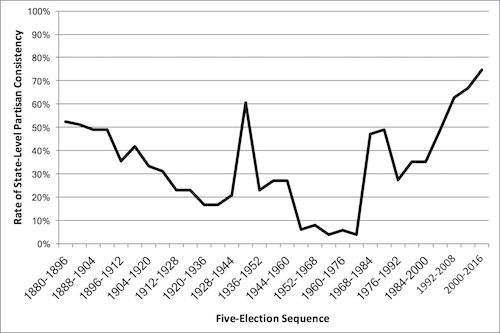
But the complete picture of the emerging electoral map in 2020 reveals far more continuity than change. The current era of presidential elections is distinguished by a historically unmatched degree of consistency in state-level partisan alignments, as depicted in this chart from my book Red Fighting Blue: How Geography and Electoral Rules Polarize American Politics:
| New Mexico | Clinton +9 | Biden +13 | Change: +4 D |
| Virginia | Clinton +6 | Biden +11 | Change: +5 D |
| Colorado | Clinton +5 | Biden +14 | Change: +9 D |
| Maine | Clinton +3 | Biden +10 | Change: +7 D |
| Nevada | Clinton +3 | Biden +7 | Change: +4 D |
| Minnesota | Clinton +2 | Biden +9 | Change: +7 D |
| New Hampshire | Clinton +0 | Biden +6 | Change: +6 D |
| Michigan | Trump +0 | Biden +8 | Change: +8 D |
| Pennsylvania | Trump +1 | Biden +5 | Change: +6 D |
| Wisconsin | Trump +1 | Biden +6 | Change: +7 D |
| Florida | Trump +1 | Biden +4 | Change: +5 D |
| Arizona | Trump +4 | Biden +3 | Change: +7 D |
| North Carolina | Trump +4 | Biden +2 | Change: +6 D |
| Georgia | Trump +5 | Trump +0 | Change: +5 D |
| Ohio | Trump +9 | Biden +1 | Change: +10 D |
| Texas | Trump +9 | Trump +3 | Change: +6 D |
| Iowa | Trump +10 | Trump +2 | Change: +8 D |
| NATIONAL | Clinton +2 | Biden +8 | Change: +6 D |