This week's Republican convention did an especially efficient job of encapsulating the current state of the party after four years of Donald Trump's leadership. In terms of the roster of speakers and the venues at which they spoke, the convention reflected how much the party has become a personal extension of Trump. Among the usual appearances by up-and-coming politicians and regular-citizen testimonials, a long succession of members of the reigning court—including a deputy chief of staff, press secretary, assistant to the president, counselor to the president, personal attorney of the president, and seven Trump family members—dominated the schedule, while the White House itself served as the backdrop to the addresses of both of its current adult occupants.
But the words of these speeches showed how much Trump's consolidation of power within the party has been accompanied by his adoption of its existing ideological commitments. Speaker after speaker at this week's convention reinforced standard Republican themes: small government, social traditionalism, veneration of the military and law enforcement, and attacks on "socialism," the "radical left," and the news media. Even the president's children, who might have been expected to spend their stage time sharing family anecdotes intended to create favorable personal impressions of their father, concentrated instead on delivering familiar conservative rhetoric. The occasional heterodoxies of the 2016 Trump campaign, which convinced many pundits and voters at the time that he was pulling the Republican Party to the left on economic policy, are no longer evident.
If there was something a bit redundant about the Republican convention, beyond the repetitive format forced in part by COVID-related restrictions, it stems from this presidency's unprecedented day-to-day domination of the political world over the past four years and the volume of coverage it already receives in both the mainstream and conservative media. Even enthusiastic supporters already have many other avenues of constant exposure to communication from Trump and his staff, and the campaign chose not to use their candidates' acceptance addresses, or the convention in general, to make much news.
It's hard to remember another presidential campaign in which concrete proposals and potential legislative initiatives have played such a minor role. Democrats have plenty of ideas for policy reform, as usual, but they did not make them the centerpiece of their public message in last week's convention; Biden's acceptance address mostly omitted the traditional "laundry list" of issue-specific domestic appeals in favor of a narrower focus on denouncing Trump as a threat to American values and mismanager of the COVID response. But the Republican convention was even more devoid of a vision for the next four years that centered on the actual powers and responsibilities of the president, as opposed to its frequent expression of emotionally charged but mostly symbolic opposition to the media, national anthem protests, destruction of local statuary, and "cancel culture." In the midst of an ongoing national economic and public health crisis that requires active, competent management to address effectively, it's remarkable that our national debate at this moment isn't more concerned with each candidate's specific plans and capacities to solve the immediate, life-threatening problem that the nation continues to face.
Thursday, August 27, 2020
Monday, August 24, 2020
"Many People Are Saying" Trump's Republican Party Doesn't Stand For Anything...But They're Wrong
Did you hear that the Republicans aren't writing a traditional platform this year? Did you read that the party has only approved a resolution pledging to "enthusiastically support the President's America-first agenda"? Did you happen to catch the quote in today's Politico story from veteran GOP congressional hand Brendan Buck, who quipped that his party has come to stand solely for "owning the libs and pissing off the media"?
Whether you're a never-Trump conservative shaking your head in mourning or a never-Trump non-conservative chortling with schadenfreude, the idea that the GOP has been reduced to a content-free cult of an ideology-free personality has an irresistably appealing emotional truth. The problem is that it doesn't have much factual truth.
Is there any confusion, or serious disagreement, over the Republican Party's current position on abortion? Or gun control? Corporate tax rates? Universal health care? Military spending? Environmental regulation?
Maybe the lack of a new platform in 2020 doesn't mean that the Republican Party is out of ideas. Maybe it shows that there is so much consensus within the party around the ideas it already has that few activists see the benefit in pressing for more internal debate.
The popular story that the Republican Party now revolves around Trump is true enough. But it often leaves out the point that Trump has won this power in part by adopting the party's existing substantive commitments. In terms of both policy and personnel, the Trump presidency is the most consistently conservative administration since Calvin Coolidge. Aside from the area of international trade (which has never been a defining issue for either major party in modern times), Trump governs in an ideologically orthodox fashion. And on some important subjects, such as immigration and international relations, he has helped to pull his party even farther to the right than it was before his arrival.
So where does the myth come from that Republicans don't stand for anything any more?
One clue comes from the types of people who seem the most invested in this argument. Today's Politico piece, which quoted Buck approvingly amidst a larger thesis that the Republican Party has abandoned any coherent animating philosophy, was written by Tim Alberta, an alumnus of the leading conservative journal National Review. Alberta's perspective is common among elite conservatives who dislike Trump: conservatism is good and Trump is not, so a Trump-led GOP is by definition a party that has forsaken its ideals.
It's true enough that Trump does not speak, or carry himself, like a National Review conservative. But that's because Trump is a Fox News conservative, not because he isn't a conservative at all. He has little interest in conservatism either as an intellectual movement built on abstract principles or as a set of moral and personal virtues, so conservative thinkers who do view their cause in such a manner naturally find it difficult to admit him to their ranks. However, the last four years have shown that most Republican voters trying to figure out what, or who, is and is not conservative pay a lot more attention to Sean Hannity's or Rush Limbaugh's thoughts on the subject than they do to Ramesh Ponnuru's or George F. Will's.
In the end, there's nothing new about the argument that the Republican Party has wandered away from true conservatism. This refrain was sounded in the later years of George W. Bush, in the final days of the Gingrich speakership, during the administration of the senior George Bush—even, at times, in the era of the otherwise sainted Reagan presidency. The conservative project of shrinking the size and role of government while simultaneously reversing leftward cultural trends is simply very difficult to achieve in practice, even when Republican politicians are in power and rhetorically committed to the cause. Donald Trump has pushed federal policy in a conservative direction across a broad spectrum of specific issues to the approval of nearly all of his fellow Republicans. That's what the Republican Party stands for, and if it wins another term, that's what it will do for another four years.
Friday, August 21, 2020
2020 Democratic National Convention Recap
Political scientists tend to like conventions more than media figures do. One reason is that journalists, whose souls are stirred most of all by the dramatic and the unexpected, are easily bored and annoyed by the packaged, stage-managed production of modern conventions, where the nomination outcome is pre-ordained and party leaders labor to hide any internal divisions or other juicy stories from public view. (Clint Eastwood's famously bizarro empty-chair routine got so much media attention at the 2012 Republican convention largely because it was a rare moment of true spontaneity.)
But another reason is that political scientists tend to like parties more than media figures do, and national conventions are above all party affairs. The nature of this year's conventions means that they can't serve as physical gatherings of the parties' human infrastructure—a real loss, even if the virtual version is a slicker and snappier experience for viewers on television. But they are still important as a unique window into how each party defines itself, and how that definition changes from one election to the next.
In most respects, the Democratic Party we saw on display this week was a familiar animal—above all, a varied coalition of social groups. Unsurprisingly, given the current climate, the topics of racial and gender equality were not only implicitly primed by the presentation of a demographically diverse succession of participants, but were also frequently invoked in speeches and voiceovers. Democrats also handed over key speaking slots to the first families of the party—the Obamas and Clintons, with a briefer but equally inevitable Kennedy appearance as well—and exploited their permanent representational advantage within the community of popular entertainment-industry professionals.
But there were also unmistakable signs of change. If the typical persuadable voter in the minds of party strategists 20 or 30 years ago was a small-town, church-going wage earner who goes hunting on the weekends, today it's more like a suburban small-business owner with Lean In on the coffee table and Beyoncé on Spotify. Democrats' former defensiveness about associations with cultural liberalism is no longer a visible element of the party's national message, and subjects that party leaders were once somewhat reluctant to discuss—gun control, feminism, LGBT rights, illegal immigration—are now central elements of its public appeal. So while Joe Biden might have been seen in the primaries by supporters and detractors alike as a kind of throwback figure representing bygone days, the campaign he's wound up running is very much a reflection of the Democratic Party's present course.
Wednesday, August 12, 2020
More on the Vice Presidential Selection of Kamala Harris
I have a new piece today in the New York Times that focuses on what the selection of Kamala Harris tells us about Joe Biden. Over the course of his long political career, I argue, Biden has always been a man of his party. He thus was unsurprisingly sensitive to pressure (or encouragement, if you prefer) from within Democratic circles to choose a woman, especially a black woman, and especially Harris. And the undeniable similarities and parallels between the figures of Harris, now very much Biden's political heir apparent, and Barack Obama merely underscore the extent to which the Democratic Party is still forged in Obama's image.
There wasn't enough room for me to touch on it in the piece, but it's become clear that Biden's organizational ties to the institutional Democratic Party are also very strong—probably stronger than those of any Democratic president since Lyndon Johnson. For example, while Obama mostly disdained and neglected the Democratic National Committee, preferring to build his own personal voter outreach structure (ultimately called Organizing for America), the Biden campaign seems to be closely integrated with the DNC and much more invested in its success. And the retrospective accounts of his vice presidential search process that are starting to pop up in the press all describe a very extensive and elaborate intelligence-gathering operation designed to synthesize input from a wide array of party actors and stakeholders.
Here are a few other final thoughts as another round of veepstakes draws to a close:
1. It's not entirely clear from the reports I've seen whether Harris was the front-runner from the beginning. But it does seem obvious that a decision was made fairly early in the process to prioritize black women and—critically—to leave other party members and the press with the same impression. Once you've signaled that you're so interested in a black running mate that you're considering multiple non-traditional picks like Susan Rice, Karen Bass, or Val Demings, you'd be running quite a risk of disappointment by settling on, say, Gretchen Whitmer instead.
2. This strategic framing by the Biden campaign is one of the reasons why the Harris pick has been described as "safe" and "obvious." She's certainly the safe choice in comparison to Rice, Bass, or Demings. But a campaign that had floated a different mix of finalists might not have produced the same response.
3. One of the important issues that this search process has demonstrated is the underrepresentation of women, especially women who aren't white, in the traditional vice presidential (and presidential) feeder offices. Harris is one of only two black women who have ever been elected to the Senate in American history (Carol Moseley-Braun, who served one term from Illinois in the 1990s, is the other), and no black woman has ever served as a state governor. In our current political moment, the demand for national elected leaders who are not white men—at least on the Democratic side—is exceeding the ready supply. If Biden had ruled out Harris, for whatever reason, he would have been faced with a real dilemma, forcing him to relax either his preference for a black running mate or the normal perceptions of the appropriate credentials for presidential office.
4. The press has made a lot of hay out of the Trump campaign's incoherent set of attacks on Harris as it simultaneously attempts to paint her, like Biden, as both a radical anti-police anarchist and an overly punitive agent of the carceral state. But my guess is that the bulk of Republican messaging, in paid advertisements and surrogate talking points, will emphasize the former claim, with the latter saved for a few targeted social media communications intended to decrease turnout on the left. As with much else in politics, follow the money: tweets are free, but TV ads are expensive.
5. The vice presidential selection is always good for a few days of media frenzy in an otherwise slow summer week for news, but it's worth remembering that running mates normally fade into the background as the fall campaign heats up (with one historical exception that is, above all, a cautionary tale). And the next VP debate to have an important effect on the presidential race will be the first one ever.
Saturday, August 01, 2020
A Few Thoughts on the 2020 Democratic Veepstakes
We've had a series of reports this week about the state of the internal deliberations over Joe Biden's selection of running mate, including from the New York Times, Politico, Politico again, Bloomberg News, and CNBC. These various accounts are consistent in some but not all respects; in particular, some suggest that Kamala Harris remains the clear favorite while others imply that her chances are fading. Here are the main points that I've taken away from the reporting so far:
1. The Biden campaign doesn't seem to be doing much to dispel the assumption that the final leading candidates are Harris, Susan Rice, and Karen Bass, with Val Demings and Tammy Duckworth still in the mix but as less probable alternatives. Of course, campaigns sometimes try to fake out reporters in advance in order to make a bigger splash when the announcement comes. But it would be an uncharacteristically risky move for the Biden team to leave the impression that they were probably going to select a black woman and then not do so.
2. There is real opposition to Harris within the party and to some extent within Biden's own orbit. This opposition is primarily personal, not based on strategic or ideological considerations. The criticism offered to the press this week that she was too "ambitious" landed badly because of its sexist overtones, but it also seemed like an intended euphemism for something more serious—selfishness? untrustworthiness?—that would have been too explosive an accusation to make without some additional evidence or corroboration.
3. But if Harris is not the final choice, Biden will need an explanation for why he preferred somebody else that can be made publicly to activists and voters, not just on background to journalists. This explanation doesn't need to be critical of Harris, but it does need to cite distinctive virtues of the alternative candidate that citizens can be expected to find duly impressive. Of the other apparent remaining contenders, Duckworth already comes with a readymade case for her selection, but the rest do not. While personal loyalty and collegiality are indeed valuable qualities in a running mate, the Biden camp would need a stronger justification than that for reaching down into the House rank-and-file or outside elective office, and one hasn't really been made so far.
4. Of all the "veepstakes" episodes in my memory, this one has been the least dominated by speculation about who might deliver a particular battleground state or key voting bloc to the national ticket and the most dominated by discussions about who might be the best vice president once the election is over. This is probably due in large part to Biden's steady lead in the polls—a rare luxury for a non-incumbent—but it is still a positive development. Whatever one might think about the way Harris or any of the other candidates have been treated, it is much better for the parties and the entire political system if leaders focus on the running mate as a potential governing partner and political successor, not as a mere tool of campaign strategy.
5. Many people seem to be operating under the assumption that Joe Biden, if elected, would not seek re-election in 2024. But it isn't very clear whether Joe Biden is one of those people.
Thursday, July 30, 2020
An Elegy for Old-Fashioned Political Campaigns in the COVID Age
The traditional campaign trail has become one of the political casualties of the COVID-19 epidemic. Joe Biden ceased holding large public events after he became the de facto Democratic nominee the week after Super Tuesday, just as the virus began its nationwide spread, and the Trump campaign has retreated to a similar policy after its comeback rally in Tulsa last month proved to be an over-hyped and under-attended disappointment. Even the president's most dedicated supporters turned out to be less enthusiastic about in-person electioneering in the midst of an uncontrolled national outbreak of disease.
It's become obvious this year how much of the standard press coverage of presidential campaigns is structured around the idea of a daily "top story" generated by the assignment of reporters and camera crews to follow the candidates around the country, ready to leap on anything that appears novel or unscripted amidst the otherwise repetitive cycle of stump speeches, rope lines, factory visits, and diner drop-ins. Most personal accounts of presidential elections written by candidates or journalists are blurry, weary travelogues that grudgingly acknowledge the democratic virtue of in-person politicking before returning to complaints about endless drudgery, exhaustion, and logistical snags.
But take away all that hopscotching from one battleground state to the next, and it's easy to wonder whether there really is a campaign at all. Joe Biden is continuing to hold virtual events and deliver policy speeches, but they simply don't seem as important—and certainly don't receive as much coverage—without big, cheering crowds and a chartered jet to schlep around the entourage. And Donald Trump's inability to hold his signature raucous rallies has helped to erase the line between presidential campaigning and presidential governing, as his COVID briefings and other White House events have come to serve as substitutes. Even if the virtual programs for the national conventions end up being snazzy productions, they will likely receive less attention than usual this year merely because they won't seem as momentous to the press or public as the in-person events of years past.
Might the lack of a traditional campaign trail affect the outcome of the election? Republicans are starting to worry that the result in November will wind up being a simple popular referendum on an increasingly unpopular admininistration—and not just in the presidential vote, but in congressional and down-ballot races as well. The Washington Post recently reported that many electorally vulnerable Republican Senate incumbents are challenging their opponents to an extensive series of debates with the hope that less-tested candidates will have a greater chance of screwing up in public, since the reduction of normal campaign events has also curtailed the usual practice of shadowing the opposing candidate with a "tracker" armed with a video camera to capture footage of any mistake. Meanwhile, Democrats have become concerned that their efforts to register new voters and mobilize sporadic participants will suffer from the relative lack of traditional grassroots activity this year.
Of course, the election was likely to serve as a referendum on Trump even before the onset of COVID, and the primary campaign arsenal of congressional candidates—paid advertising—remains unaffected by the current crisis. Interested would-be voters who have postponed registration so far may start to register in greater numbers as the election starts to approach, and the atmosphere of national crisis could also boost participation independent of organized get-out-the-vote initiatives. So the reduction of in-person campaigning this year may well have little effect on the outcome of the 2020 elections.
But the lack of so many familiar trappings of American political culture, from hand-shaking and small talk at midwestern state fairs and ice cream shops to the quadrennial spectacles of the national conventions, is still something worth mourning in our moment of disruption and isolation. Sure, a lot of this activity was formally obsolete and (for candidates, staff, and journalists) sometimes annoyingly inconvenient. But why should political campaigns necessarily be conducted for the maximum comfort or entertainment of their professional participants? Like so many other social rituals, these practices have taken on a meaning of their own as symbols of participatory democracy, and their absence—hopefully a temporary one—should rightfully be lamented as a small part of all that has been lost in this very sad year.
Monday, July 20, 2020
The South Is Still Very Republican—But Southern Democrats Aren't "Southern Democrats" Anymore
In an era of historically stable electoral maps, any hint of novelty is likely to attract a much greater degree of attention than its true importance would warrant. And so recent signs of an electoral trend favoring Democratic candidates in certain corners of the South have been repeatedly touted as earth-shaking developments; Friday's Wall Street Journal even refers to a potential "realignment" in the region. If the news media's prototypical voter of interest after the 2016 election was the (pro-Trump) working-class white resident of a small midwestern town, in 2020 the new objects of fascination are the (anti-Trump) well-educated professionals and voters of color populating the suburbs of large southern cities like Atlanta, Charlotte, and Houston.
But the South as a whole is still very Republican—in fact, it remains the main source of popular support for the national Republican Party. Among the 14 southern states (defined here as the 11 members of the former Confederacy plus West Virginia, Kentucky, and Oklahoma), Democrats have built an overall advantage in just one (Virginia), and in only Florida and North Carolina are the two parties closely matched at the state level. Across the rest of the region, Republicans control all 22 state legislative chambers, 9 of 11 governorships (having lost only Kentucky and Louisiana by narrow margins in off-year elections to replace unpopular Republican incumbents), 20 of 22 U.S. Senate seats (all but those held by Joe Manchin of West Virginia and Doug Jones of Alabama, the last an accidental special election winner who is unlikely to retain his seat this fall), nearly every other statewide office, and 74 of 101 U.S. House seats.
The Democratic Party hit a historic low point in the South during the 2014–2016 period and has made a bit of a comeback since then, as it has elsewhere in the country. But this partisan rebound has so far been mostly restricted to a few major metropolitan areas, flipping some congressional and state legislative seats to Democratic challengers without yet dismantling the power of a formerly dominant state Republican Party. Yes, Beto O'Rourke in Texas and Stacey Abrams in Georgia represented tantalizing near-miss candidacies for Democrats in 2018, though both also benefited from flawed opponents and unusually favorable national partisan conditions—the same electoral assets that have so far kept Joe Biden within reach of carrying both states this year. But if national polls start to tighten before November, the Biden campaign will probably retreat to defend pivotal states elsewhere, abandoning the ambitious but unnecessary goal of making additional inroads in the South.
In general, the change so far in the southern Democratic Party's electoral strength has received too much attention and the change in its internal complexion has received too little. Old-style southern Democrats—the kind with rural constituencies, good-ol'-boy personas, and philosophical discomfort with the northern wing of the party on issues from abortion and gun control to environmental regulation and energy policy—are nearly extinct in elective office; Manchin, Louisiana governor John Bel Edwards, and one or two House members are just about the last of this breed above the local level. The newer generations of southern Democratic politicians are much more likely to be drawl-less metropolitans, often first- or second-generation transplants from outside the region. Many of them are members of racial minority groups, even in majority-white constituencies. And they are mostly not ideological misfits within the national Democratic Party, instead sitting squarely inside the prevailing Obama-Biden pragmatic liberal mainstream on economic and social issues alike.
When Democrats gained a majority in both houses of the Virginia legislature last November, achieving unified control of state government for the first time in decades, they immediately demonstrated how much the state party had evolved since the days when it was led by conservative-leaning figures like Harry Byrd and Howard "Judge" Smith. The burst of legislative activity that ensued not only raised the state minimum wage and imposed regulations on energy producers; it also loosened restrictions on abortion, banned discrimination on the basis of sexual orientation, closed the "gun show loophole" by requiring background checks for all firearm purchases, decriminalized marijuana possession, and allowed local governments to remove Confederate monuments. This is the contemporary policy agenda of regular national Democrats, making few concessions to the distinctive cultural commitments of traditional southern politics, and any future Democratic majority in North Carolina, Florida, Texas, or Georgia is more likely to follow Virginia's lead than to attempt to revive the old style of governing.
Even if they benefit from another "blue wave" this year, Democrats are still a long way away from true competitiveness in most of the South. But the evolution of its main sources of electoral support in the region is important for the behavior of the party at the national level. Democrats elected from southern congressional seats are less likely to be as serious an impediment to the legislative agenda of the next Democratic president as they were to that of Obama or Bill Clinton, in part because the constituencies that they represent are less self-consciously "southern," less alienated from national left-of-center politics, and moving toward, rather than away from, the Democratic Party over time. Republicans are still very much the party of the South, but Democrats are hoping to eventually become the party of the New South.
Monday, July 06, 2020
Were Democratic Voters Right About Biden's Electability?
The idea that there is often a difference between the candidate you love the most and the candidate who has the best chance to win is a long-standing fixture of nomination politics, especially in the Democratic Party. But the assumption that "electability" is a quality shared by some potential nominees more than others, and even that it is a valid criterion of candidate selection, was disputed more than usual in the 2020 Democratic presidential primaries. Though it requires diving back into what now seems like a long-ago pre-COVID political world, it's worth revisiting this debate from the perspective of the summer campaign and the current state of the general election race.
Electability was a fraught subject in the 2020 Democratic nomination contest partially because of the perception of a significant ideological divide within the party, made more salient by the viable candidacy of self-described socialist Bernie Sanders. Sanders's lack of defensiveness about his philosophical commitments made him an admirable figure in the eyes of his supporters, but also provoked considerable opposition to his prospective nomination among other Democrats—including most of the party's elected officials and a large proportion of its activists and organizational leadership.
Layered on top of this familiar debate over whether a tradeoff exists between electability and ideological purity was another set of concerns about candidates' social identities. Many Democrats had deduced from the racist backlash after Barack Obama's 2008 election and the unexpected defeat of Hillary Clinton in 2016 that non-white and (especially) female presidential candidates are likely to lose votes due to the persistence of popular prejudices. Even though they supported the general goal of increasing the demographic diversity of the nation's officeholding class, a number of Democratic primary voters proceeded to draw the natural conclusion that nominating a white male presidential candidate for the first time since 2004 would be the safest path to ejecting the hated Trump from office.
But the prevalence of this view dismayed some feminist commentators, who continued to ascribe Trump's political rise to the prevalence of misogyny in the American public but who objected when this argument was then cited as justification for supporting a male nominee to oppose him. In the young progressive circles that are disproportionately well-represented in the online world, it was common either to reject the electability logic altogether or to claim that it actually favored candidates on the left. The science reporter at a well-known "explainer" website even argued that because differences in the relative potential strength of prospective nominees cannot be determined precisely in advance, the entire concept was dubious even in the abstract: "it's subjective, not objective . . . electability ain't no science." (Normally, the scientific mode of inquiry tends to make a stronger distinction between the difficulty of measuring a phenomenon and the existence or absence of the phenomenon itself.)
Despite these assertions, a coalition of the Democratic Party's most pragmatic constituencies—including African-Americans, southerners, upscale suburbanites, and senior citizens—ultimately rallied behind Joe Biden's self-presentation as the safest choice to send into battle against Trump. Now that we're about midway between the point in March at which Biden became the presumptive Democratic nominee and the date of the November election, it's time to re-evaluate the electability debate in light of how the campaign has proceeded so far.
From one perspective, the electability argument for Biden has been completely vindicated. Biden has opened up a bigger lead over Trump in the national popular vote than any candidate has enjoyed at this stage since Bill Clinton coasted to re-election in 1996, and he is so well-positioned in the electoral college that the battleground map has expanded into the traditional red territory of Arizona, Georgia, and even Texas. The Trump campaign has proven unable as of yet to land a damaging punch on Biden, and has even struggled to find a promising line of attack.
Biden hasn't been as invisible a candidate as some critics claim, but his campaign activities during the pandemic have not generated much sustained attention. Because journalists do not find the very familiar Biden to be a particularly fruitful source of interesting stories, the national media has been focusing instead almost entirely on Trump, and Trump's spiraling political problems, since the Democratic nomination wrapped up after Super Tuesday. The relative novelty of nearly every other major potential nominee—Sanders, Elizabeth Warren, Pete Buttigieg—would have attracted more coverage from the media and pulled the spotlight away from Trump much more frequently.
On the other hand, Biden's current success surely reflects the sinking fortunes of Trump's presidency more than any particular attribute or skill of his own. Even more than most, this election promises to serve as a referendum on the performance of the incumbent; perhaps any plausible Democratic nominee would have opened up a steady lead after the events of the past few months. As Trump's approval ratings continue to slide, supporters of Democratic candidates who were deemed less electable in the primaries might justifiably feel in retrospect that 2020 may well turn out to be a missed opportunity. Perhaps the party could have taken the additional risk associated with a non-white-male or more left-wing nominee while still retaining a good chance of victory.
Because we lack access to the parallel universes in which other nominees were chosen, it's impossible to completely settle the electability debate. However, enough evidence now exists to shed light on two claims made by some advocates of non-Biden candidates in the 2020 Democratic primaries. One is that there are so few remaining swing voters in our current age of rampant polarization that mobilization of the party base is more productive than trying to achieve a broader appeal, and the other is that a Biden nomination would not excite enough voters on the left to stimulate this necessary mobilization.
Both of these claims have already been contradicted by the polls. Biden wouldn't have pulled into the strong lead he now holds if he weren't drawing significant support from previous Republican voters. (According to recent surveys by the New York Times, 14 percent of battleground state residents who supported Trump in 2016 are not supporting him in 2020.) After years of media stories about Trump’s skill in stoking the passionate devotion of his own party, the last few months have forced a widespread journalistic rediscovery of the importance of swing voters and the danger of Trump's declining popularity among this still-pivotal bloc. And while Biden himself doesn't inspire as much personal enthusiasm among Democrats as Trump does among many Republicans, overall levels of interest in the election are equal across party lines: Democratic voters are as motivated to vote against the president as Republicans are to vote for him.
There are still four months to go in the campaign, which is still plenty of time for the prevailing dynamic to change. Republicans have become concerned that Biden's status as a elderly white man who isn't a socialist means that the familiar playbook of accusing Democrats of supporting left-wing extremism or revolutionary social change won't work as well against him as it would have against other potential nominees. But Biden's to-be-announced running mate will be a woman, probably a woman of color, and quite possibly a woman of color with a more liberal record than his. It's likely that she will wind up serving as the target of these attacks, with Biden himself portrayed by the Trump campaign as too hapless and mentally impaired to prevent her from imposing her "radical" agenda on the nation if elected. Just because Biden won the Democratic nomination by promising to transcend divisions of race, gender, and ideology doesn't mean that the fall campaign won't once again be dominated by these highly-charged subjects.
Thursday, June 25, 2020
Will 2020 Dim the Myth of the Campaign Guru? Let's Hope So
Michael Deaver. Ed Rollins. Lee Atwater. James Carville. Dick Morris. Karl Rove. David Axelrod. Steve Bannon.
Every recent president has had at least one top advisor who has been given generous credit for being the strategic mastermind behind his political success—credit that these operatives have seldom discouraged. As the conduct of campaigns has become more professionalized over time and the press has devoted more attention to the game within the political game, strategists and consultants have increasingly become famous in their own right. These figures are considered worthy of awe based on the assumption that the choices that they make during the course of the campaign—which messages to adopt, which ads to produce, which voters to target, how to attack the opposition—are likely to be crucial to the outcome.
These choices are important, and in a close election they might indeed be decisive. But there is reason to believe that the influence of campaign activity and strategy over electoral results is much more modest than it is often assumed to be, especially in the general elections for the presidency that command the most attention and publicity. For example, we can get a fair way toward predicting the final vote distribution in any particular election simply by accounting for a few basic variables like the state of the national economy, the identity of the party in power, and whether or not the incumbent is running—all factors that lie outside the campaign itself.
The quadrennial celebration of the key strategists behind the winning candidate as unrivaled masters of the political arts usually reflects an assumption that the outcome proved them to be savvier or more ruthless than their counterparts in the losing camp. But most of the time, there are equally smart and tough people on both sides of a race. One competitor will inevitably be elected and the other defeated—it's the nature of the business—but that doesn't mean that the winners are always geniuses and the losers always incompetents.
Interestingly, the 2020 election may be the first in a while that has not generated substantial press coverage of the top professional staffers in the two major presidential campaigns. Of course, there are other big stories to cover these days. But these stories have themselves managed to illustrate how elections can be powerfully influenced by forces independent of the campaigns themselves—forces like a pandemic, or a recession, or a newly energized social movement.
The 2020 race has also demonstrated how elections with an incumbent seeking another term in office tend to become a referendum on that incumbent's perceived performance. President Trump's strategic decisions have indeed had electoral effects, but those decisions do not appear to be guided by aides within his campaign apparatus. His current organization lacks a Bannonesque svengali figure able to provide a coherent intellectual frame to his quest for re-election. And since Trump's recent behavior has coincided with, and probably contributed to, a notable slide in the polls, there aren't too many subordinates eager to take credit for his candidacy's current trajectory in conversations with reporters.
And then there's Joe Biden. Biden engineered a fairly remarkable comeback in the Democratic nomination contest and has now pulled into a national lead unmatched at this stage of the campaign by any candidate in either party since Bill Clinton's 1996 re-election. Yet neither he nor his brain trust seem to be getting much credit in the media for this record of success: the resurrection of his primary campaign is mostly attributed either to Jim Clyburn throwing him a rope in South Carolina or to the fortuitous mistakes of the Sanders, Warren, and Bloomberg candidacies, and his growing lead in the general election race is similarly laid at Trump's feet. (I'd guess that even many regular consumers of political media would have trouble recalling the name of Biden's campaign manager; I certainly did before writing this post.) With the pandemic limiting his ability to wage a visible campaign, Biden has received a certain respect only for having enough patience and base cunning to stay out of the way as Trump's position deteriorates.
The press isn't being particularly unfair to Biden and his aides. But it has misled in the past by overstating the importance of strategic maneuvering by campaign gurus, excessively hyping the presumed architects of electoral victory while disparaging the unsuccessful team for supposedly blundering its way to defeat. If the 2020 election provides an unusually dramatic example of the fundamental importance of external factors and the limited power of short-term tactics, it will provide us with a useful lesson in the true nature of presidential campaigns. Yes, hiring a brilliant political mind can sometimes help win the White House. But with the most important factors remaining out of the hands of the candidates and their staffs, the biggest electoral asset of all remains sheer luck. Maybe what was needed to finally convince the media of this fact was Joe Biden—whom one prominent New York Times reporter recently called a “very flawed candidate running a flawed campaign”—nevertheless becoming a heavy favorite to be the next president.
Wednesday, June 17, 2020
"New" States Get the Hype, But the Electoral Map Hasn't Changed Much in 2020
To a certain type of election-watcher, there are few things more exciting than witnessing a state that was once loyally partisan transform into a fiercely contested battleground. Recent public opinion surveys suggesting that Joe Biden is running a close race against Donald Trump in Texas and Georgia—two traditional Republican bastions that have not been competitive in presidential elections since the 1990s—and now leads in Arizona, which has voted Democratic for president only once (1996) in the past 70 years, have, unsurprisingly, received widespread attention from political commentators.
But the complete picture of the emerging electoral map in 2020 reveals far more continuity than change. The current era of presidential elections is distinguished by a historically unmatched degree of consistency in state-level partisan alignments, as depicted in this chart from my book Red Fighting Blue: How Geography and Electoral Rules Polarize American Politics:
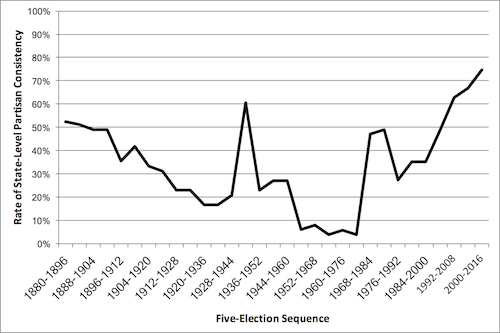
But the complete picture of the emerging electoral map in 2020 reveals far more continuity than change. The current era of presidential elections is distinguished by a historically unmatched degree of consistency in state-level partisan alignments, as depicted in this chart from my book Red Fighting Blue: How Geography and Electoral Rules Polarize American Politics:
Of the 37 states (plus the District of Columbia) that voted for the same party's nominees in each of the five presidential elections between 2000 and 2016, Arizona, Georgia, and Texas seem to be the only plausible candidates to break their streak in 2020—unless the next few months turn so dramatically in Donald Trump's favor that he manages to carry Minnesota or Maine. But even the potential addition of new Sun Belt territory to the familiar Midwest-centered battleground state map doesn't mean that there has been a significant partisan realignment of the South or Southwest over the past four years. What the close recent polls in these states really indicate is not that Trump has developed an unusual regional weakness, but rather that Biden now has a national lead strong enough to pull a few Republican-leaning states into the "competitive" category.
If we compare the two-party popular vote outcome in 2016 with today's two-party polling margin as estimated by The Economist's daily forecasting model for the 16 states where both parties received at least 45 percent of the vote in the last election, we see (after accounting for sampling error and variations in data quality) what looks like a fairly uniform pro-Democratic shift nationwide:
| New Mexico | Clinton +9 | Biden +13 | Change: +4 D |
| Virginia | Clinton +6 | Biden +11 | Change: +5 D |
| Colorado | Clinton +5 | Biden +14 | Change: +9 D |
| Maine | Clinton +3 | Biden +10 | Change: +7 D |
| Nevada | Clinton +3 | Biden +7 | Change: +4 D |
| Minnesota | Clinton +2 | Biden +9 | Change: +7 D |
| New Hampshire | Clinton +0 | Biden +6 | Change: +6 D |
| Michigan | Trump +0 | Biden +8 | Change: +8 D |
| Pennsylvania | Trump +1 | Biden +5 | Change: +6 D |
| Wisconsin | Trump +1 | Biden +6 | Change: +7 D |
| Florida | Trump +1 | Biden +4 | Change: +5 D |
| Arizona | Trump +4 | Biden +3 | Change: +7 D |
| North Carolina | Trump +4 | Biden +2 | Change: +6 D |
| Georgia | Trump +5 | Trump +0 | Change: +5 D |
| Ohio | Trump +9 | Biden +1 | Change: +10 D |
| Texas | Trump +9 | Trump +3 | Change: +6 D |
| Iowa | Trump +10 | Trump +2 | Change: +8 D |
| NATIONAL | Clinton +2 | Biden +8 | Change: +6 D |
Polling estimates are, of course, inexact, and all three of the new Sun Belt battlegrounds had already swum against the national tide by becoming "bluer" between 2012 and 2016. But the best recent evidence indicates that these states remain more Republican than the national average, and are currently competitive mostly because Biden is well ahead in the overall popular vote. Even so, Biden appears to have a consistent lead only in Arizona, and he still trails Trump in Texas.
If Biden's current advantage is changing the electoral map in some ways, it's working against change in others. After Trump won Ohio and Iowa by unusually wide margins in 2016, some analysts speculated that both states would lose battleground status in 2020, conceded to the GOP from the start of the campaign. Ohio and Iowa remain clearly Republican-leaning in 2020 compared to the nation as a whole, but Biden's overall lead allows him to keep both states in play (at least for now), and the Trump campaign is indeed spending money to defend them.
A scenario in which Biden maintains or expands his current margin would allow Democrats to consider deploying campaign resources into these states in pursuit of a decisive national victory and gains in downballot offices. But if the race starts to tighten, diverting attention to red-leaning states will be considerably less appealing, and Democratic dreams of "expanding the map" will need to wait for a future contest. Either way, the electoral college outcome in 2020 is still likely to pivot on the four states that Trump carried by narrow margins in 2016: Michigan, Pennsylvania, Wisconsin, and Florida. And there's nothing new at all about those particular states deciding who the next president will be.
Thursday, June 11, 2020
The Surge in Female Congressional Candidates Keeps Going in 2020—And Now It's Bipartisan
One of the major political events of 2018 was a sudden, historically unparalleled surge of women running for office—a development that reflected the energetic political mobilization of women within the Democratic Party after the election of Donald Trump over Hillary Clinton two years before. The Congress that took office in January 2019 contained a record 102 female members of the House of Representatives and 25 female senators. (Since then, the number of women has decreased by 1 in the House and increased by 1 in the Senate.) In both chambers, the partisan distribution is heavily skewed: Democratic women currently outnumber Republican women by a margin of 88 to 13 in the House and 17 to 9 in the Senate.
The congressional elections of 2020 have received much less notice than those of two years ago; apparently there are a few other big national stories to divert Americans' attention these days. But with slightly more than half of the year's House nominations having been decided by the primary voters of the two parties as of mid-June, it's worth checking in to see whether last election's explosive rise in female nominees has carried over to the current contest. As the figure below shows, the surge has not only continued among Democrats, it has spread to the Republican Party as well:

The share of female House nominees in the Democratic Party shot up from 29 percent in 2016 (itself a record at the time) to 42 percent in 2018; this year, it has increased still further to 48 percent as of this week—within reach of a numerically equal gender balance. The growth has been even sharper when incumbents, still a mostly male group, are excluded: from 27 percent in 2016 to 49.8 percent in 2018 to 58 percent (so far) in 2020. Whether or not the Democrats make history this year by nominating more total women than men for the House, they are on track to be the first party ever to nominate more non-incumbent women than non-incumbent men.
For Republicans, 2018 did not bring a sudden rise in female candidates. But 2020 very much did. So far this year, women constitute 21 percent of all Republican nominees for the House and 33 percent of all non-incumbent nominees—a dramatic increase from two years ago (when the final figures were 13 percent and 18 percent, respectively) and all previous years. The gap between the parties is still substantial, but is on track to narrow slightly from its 2018 size.
We'll need further research to know for sure, but I suspect that the dynamics driving these changes are somewhat different in each party. On the Democratic side, the Trump era has brought a sudden increase in women motivated to seek political power in response to his unexpected victory, combined with what appears to be an increasing preference among Democratic voters for female congressional nominees. In many strongly Republican districts that are not being seriously contested by the national parties, it seems that simply having a female name has often become a key ballot advantage for otherwise unknown Democratic candidates running among a field of equally unknown male primary opponents.
For Republicans, the new spike in female congressional nominees is more likely a product of initiatives by party leaders to recruit more women to run for office, in order to counteract a perceived reputation for demographic exclusivity. Republican officials have recently attempted to bring more gender diversity to the party, as reflected in the appointment over the past two years of three Republican women (Cindy Hyde-Smith of Mississippi, Martha McSally of Arizona, and Kelly Loeffler of Georgia) to fill vacant seats in the U.S. Senate.
Though women are much better represented on the candidate slates of both major parties than they have been in the past, the November election is unlikely to produce a 2021–2022 Congress with a large number of new female faces. Most challengers in congressional races are perennially destined to lose, and 2020 seems likely to be a more friendly election for incumbents than 2018 was. A few seats now held by retiring male representatives are likely to elect women this fall, including Iowa-2, Illinois-15, and Texas-24, but a few others may well replace departing women with male successors, including Alabama-2, Hawaii-2, and New York-17.
And in the Senate, it's quite possible that the number of women will actually decline in 2021. McSally and Loeffler both face serious challenges by male opponents in this fall's elections (two other electorally vulnerable incumbents, Susan Collins of Maine and Joni Ernst of Iowa, would be replaced by other women if they lose in November). At least five sitting senators—Kamala Harris of California, Amy Klobuchar of Minnesota, Elizabeth Warren of Massachusetts, Tammy Duckworth of Illinois, and Tammy Baldwin of Wisconsin—are plausible choices for the vice presidential slot on the Democratic national ticket, with no guarantee that a victorious running mate would be replaced in the Senate by another woman.
The only seat now occupied by a male senator that is more likely than not to elect a woman in 2020 is Wyoming, where Republican Cynthia Lummis is a heavy favorite to succeed the retiring Mike Enzi. Elsewhere, the female candidate with the best shot of winning a seat currently held by a man seems at this stage to be Democrat Barbara Bollier of Kansas, but she remains a clear underdog whose chances of winning a normally red state probably depend on the Republicans nominating a weak opponent in the August 4 primary. So while this year's congressional elections are shaping up to be a notable milestone in female representation within both major parties, next year's Congress will not be in position to make similar history.
The congressional elections of 2020 have received much less notice than those of two years ago; apparently there are a few other big national stories to divert Americans' attention these days. But with slightly more than half of the year's House nominations having been decided by the primary voters of the two parties as of mid-June, it's worth checking in to see whether last election's explosive rise in female nominees has carried over to the current contest. As the figure below shows, the surge has not only continued among Democrats, it has spread to the Republican Party as well:
The share of female House nominees in the Democratic Party shot up from 29 percent in 2016 (itself a record at the time) to 42 percent in 2018; this year, it has increased still further to 48 percent as of this week—within reach of a numerically equal gender balance. The growth has been even sharper when incumbents, still a mostly male group, are excluded: from 27 percent in 2016 to 49.8 percent in 2018 to 58 percent (so far) in 2020. Whether or not the Democrats make history this year by nominating more total women than men for the House, they are on track to be the first party ever to nominate more non-incumbent women than non-incumbent men.
For Republicans, 2018 did not bring a sudden rise in female candidates. But 2020 very much did. So far this year, women constitute 21 percent of all Republican nominees for the House and 33 percent of all non-incumbent nominees—a dramatic increase from two years ago (when the final figures were 13 percent and 18 percent, respectively) and all previous years. The gap between the parties is still substantial, but is on track to narrow slightly from its 2018 size.
We'll need further research to know for sure, but I suspect that the dynamics driving these changes are somewhat different in each party. On the Democratic side, the Trump era has brought a sudden increase in women motivated to seek political power in response to his unexpected victory, combined with what appears to be an increasing preference among Democratic voters for female congressional nominees. In many strongly Republican districts that are not being seriously contested by the national parties, it seems that simply having a female name has often become a key ballot advantage for otherwise unknown Democratic candidates running among a field of equally unknown male primary opponents.
For Republicans, the new spike in female congressional nominees is more likely a product of initiatives by party leaders to recruit more women to run for office, in order to counteract a perceived reputation for demographic exclusivity. Republican officials have recently attempted to bring more gender diversity to the party, as reflected in the appointment over the past two years of three Republican women (Cindy Hyde-Smith of Mississippi, Martha McSally of Arizona, and Kelly Loeffler of Georgia) to fill vacant seats in the U.S. Senate.
Though women are much better represented on the candidate slates of both major parties than they have been in the past, the November election is unlikely to produce a 2021–2022 Congress with a large number of new female faces. Most challengers in congressional races are perennially destined to lose, and 2020 seems likely to be a more friendly election for incumbents than 2018 was. A few seats now held by retiring male representatives are likely to elect women this fall, including Iowa-2, Illinois-15, and Texas-24, but a few others may well replace departing women with male successors, including Alabama-2, Hawaii-2, and New York-17.
And in the Senate, it's quite possible that the number of women will actually decline in 2021. McSally and Loeffler both face serious challenges by male opponents in this fall's elections (two other electorally vulnerable incumbents, Susan Collins of Maine and Joni Ernst of Iowa, would be replaced by other women if they lose in November). At least five sitting senators—Kamala Harris of California, Amy Klobuchar of Minnesota, Elizabeth Warren of Massachusetts, Tammy Duckworth of Illinois, and Tammy Baldwin of Wisconsin—are plausible choices for the vice presidential slot on the Democratic national ticket, with no guarantee that a victorious running mate would be replaced in the Senate by another woman.
The only seat now occupied by a male senator that is more likely than not to elect a woman in 2020 is Wyoming, where Republican Cynthia Lummis is a heavy favorite to succeed the retiring Mike Enzi. Elsewhere, the female candidate with the best shot of winning a seat currently held by a man seems at this stage to be Democrat Barbara Bollier of Kansas, but she remains a clear underdog whose chances of winning a normally red state probably depend on the Republicans nominating a weak opponent in the August 4 primary. So while this year's congressional elections are shaping up to be a notable milestone in female representation within both major parties, next year's Congress will not be in position to make similar history.
Thursday, June 04, 2020
Trump, the Floyd Protests, and the End of Confident Conservatism
After Richard Nixon's 1968 election, many conservatives came to believe that their movement naturally represented the political views of most Americans. This conservative faith in the wisdom of the average citizen was cemented by Ronald Reagan's popularity in the 1980s, which was widely interpreted at the time (and not just by conservatives) as a decisive expression of the nation's exhaustion with both outdated New Deal economic policies and decadent '60s-era cultural practices. America's mistaken dalliance with liberalism was a passing phase that it was maturing out of, argued the Reaganites, and both the present and future belonged to the right. Reagan himself projected this sunny confidence in the nation's judgment, serenely dismissing liberal expressions of outrage in the same manner that he responded to the attacks of the hapless Jimmy Carter by half-chuckling "there you go again."
Bill Clinton's presidency temporarily shook, but did not ultimately damage, the confidence of the conservative movement. Conservatives found ways to explain away Clinton's electoral success, claiming that he only won because George H. W. Bush had betrayed conservatism by raising taxes, because Ross Perot's independent candidacies temporarily drained conservative votes away from the Republican Party, and because Clinton's slippery political style deceived the electorate about his true nature. Republican capture of both houses of Congress in 1994 for the first time in four decades, combined with a similarly dramatic set of electoral gains at the state and local level, continued to suggest to conservatives that they represented the future of American politics, and several major milestones in the Clinton presidency, from the government shutdown of 1995–1996 to the impeachment of 1998–1999, were conflicts precipitated by conservative leaders who had assured themselves (sometimes incorrectly) that most of the public would side with them in a fight.
Despite the close margin, controversial resolution, and discrepancy between the popular and electoral votes, conservatives generally treated the 2000 election as something of a restoration after an eight-year usurpation, underlined by the fact that the new Republican president was the eldest son of the last Republican president. Especially after the declaration of the War on Terror, the presidency of George W. Bush styled itself as the authentic, patriotic voice of the vast American interior, and mocked its critics as a vocal but small group of coastal elites. Bush's top political aide Karl Rove repeatedly expressed ambitions to construct a durable Republican advantage in the manner of his political hero William McKinley, whose 1896 election marked the beginning of a 36-year stretch of Republican dominance of national politics.
With a few strategic concessions to the nation's changing demographic trends—education reform to appeal to suburban professional women, a softer tone on race and immigration to cultivate a Republican vote among Hispanics—the Bush program of "compassionate conservatism" envisioned a stable popular majority supporting a policy agenda of laissez-faire economics, religious traditionalism, and interventionist military engagements overseas. But the failures and misfortunes of Bush's second term opened the door to the election of Barack Obama in 2008. In retrospect, this was a key turning point in the psychology of the conservative movement.
Obama represented a new and more serious challenge to conservatism's conception of itself as uniquely speaking on behalf of the American public. His race was an important element of this threat, but not the only one. In contrast to Clinton's "triangulation" strategies and propensity to echo conservative tributes to limited government and personal responsibility, Obama made few substantive or symbolic concessions to conservatism. His policies were farther left than his predecessor's, and he succeeded in enacting health care reform where Clinton had failed. He was from Chicago, not small-town Arkansas. And he rode into office on the support of younger voters who represented the generational future of American politics, and who seemed especially resistant to the appeals of his conservative opponents.
Conservative confidence in the nation's long-term direction became notably scarce in the Obama years, as widespread pessimism and fear replaced Reagan's cheerful assuredness. The popular backlash on the right against the "change" that Obama himself claimed to personify was stronger than it had been against Clinton, taking aim at the traditional leadership of the Republican Party as well as the Democrats. Rather than selecting yet another member of the Bush family to succeed Obama, Republican primary voters opted to nominate Donald Trump, an outsider candidate who had built his campaign around passionate contempt for Obama and the state of the nation under his watch.
But whatever expressive purpose the decision to elect him may have served, the current president is ill-equipped to usher in a new conservative age. Trump is not a friendly face with the charisma to increase conservatism's mass appeal, like Reagan was. He is not a man with a 40-year plan, like Rove was. And any hopes that his glowering demeanor and vengeful preoccupations would either intimidate liberals into silence or halt the progression of larger social changes have clearly not been realized. In part because Trump has inspired a backlash of his own, conservatives do not seem much more comfortable with the direction of America today than they were four years ago.
The waning confidence of the American right in its own popular standing has produced other manifestations as well. Its imprint can be seen in conservative opposition to measures designed to increase the ease of voting, in negative portrayals of "millennials" and college students in the conservative media, and in an increased emphasis on the unelected federal judicial branch, rather than the congressional legislative process, as an avenue for conservative policy-making. Perhaps most dramatically, it is expressed by the more frequent displays of firearms at conservative protest events—a clear suggestion that the use or threat of physical force might be necessary to compensate for losses in the court of public opinion.
The current crisis in the streets of America has roots that stretch in many different directions, but it has surely been exacerbated by the current administration's propensity for confrontation with the many perceived enemies that surround it. It's not especially important that Trump apparently moved briefly to the bunker under the White House last week in the face of protests outside the building—a subject of liberal mockery in recent days—but it's crucial that the administration's governing approach from its inception has reflected a bunker mentality. The protestors gathering daily outside the White House and in cities and towns all around the country since the George Floyd killing have come to embody the threat of cultural besiegement that many conservatives, including those in law enforcement professions, have been feeling since 2008.
Trump has started to echo Nixon's famous invocation of a supportive "silent majority." But he is the only president in the history of public opinion polling who has never had a majority of Americans on his side, even on his first day in office, and he has never shown much interest in courting skeptics rather than attacking them. Winning a second term will likely require him to eke out a narrow margin in the electoral college, very possibly without a popular-vote plurality once again. The current governing regime seeks to retain political power from behind barricades that are primarily psychological, separated in spirit more than in physical distance from a growing population of fellow Americans whom it no longer trusts to be on its side. When you see your own domestic political opponents as an irredeemably hostile force trying to destroy the country as you know it, perhaps it's only natural to fantasize about calling in the troops.
Tuesday, May 26, 2020
Why COVID Was Never Going to Produce National Unity
The presidency of Donald Trump is often treated as if it represents a dramatic new development in American politics, but it's likely that future generations looking back on this time in history will be somewhat surprised, or even amused, by the prevalence of such a view. In many ways, Trump is more interesting, or important, as a fulfillment of existing trends reaching back decades into the past than he is as an innovator in his own right. In retrospect, a Trump-like figure rising to power within the Republican Party can, and probably will, be seen as a completely natural development.
The current historical moment is merely the point at which the barrier previously separating the increasingly-dominant media wing of the American conservative movement from its traditional officeholding wing suffered a serious structural buckle, catapulting many of the media types—with their distinctive preoccupations, motivations, and rhetorical styles—into positions of governing power. Put another way, the Trump administration is more or less a real-life simulation of what would have happened if Rush Limbaugh had been elected president. Journalists and attentive citizens often gasp at this or that example of "unprecedented" Trumpian behavior and marvel that they can't picture Barack Obama—or George W. Bush, or Ronald Reagan—ever saying or doing such a thing. But if the question were instead "can you imagine a President Limbaugh saying or doing that?" the answer is nearly always yes.
Many observers have expressed amazement at how quickly the nationwide public health crisis of COVID-19, itself not inherently an ideological or divisive issue, has evolved to conform to the outline of familiar culture-war conflicts. But to the media outlets that now exercise substantial influence over the national Republican Party, culture war is what politics is all about. In the world that they construct for their audiences, conservatism is in the position of defending America itself against ceaseless attack from Democratic politicians, liberal interests, and a mainstream news media all bent on its destruction or catastrophic transformation. In this constant state of emergency, there is little room to prize non-ideological values such as governing competence or policy expertise, and any form of compromise with the political opposition is tantamount to capitulation.
Even during periods of Republican rule, the content of conservative media programming focuses more on criticizing Democrats and the non-conservative media than on celebrating conservative electoral or governing successes. An emergence of national unity, with the leaders and members of both parties agreeing to implement public policies developed by non-partisan experts to address a widespread threat to the well-being of all citizens, wouldn't just undercut the arguments that liberals are wrong about everything and that government power cannot be leveraged productively for universal benefit. It's even worse than that: what would the conservative media talk about every day?
Trump's own instincts lie in the same direction. Unlike previous leaders of both parties, he ran for the presidency not by vowing to bring the country together but instead by promising constant conflict with an array of perceived enemies inside as well as outside its borders. Intermittent expectations that Trump might seek to "rise above" mere political warfare were thus unrealistic: in his view, the warfare is the whole point. The idea of approaching the current crisis with a bipartisan spirit is as incomprehensible to him as it would be to any Fox News host, and both Fox and the White House have quickly reverted to their common comfort zone of the partisan firing range: questioning the need for social distancing restrictions and even the severity of the disease itself while accusing Democrats, journalists, and scientists of using the crisis as a cover to sabotage the president.
But an important difference remains between officeholding conservatives and media figures: talking heads don't need to win over a plurality of eyeballs to build long and successful careers, but politicians can only stay in power by attracting more votes, whether popular or electoral, than the other side. The all-culture-war-all-the-time attitude is more reliable as a means of building a loyal audience in a splintered media marketplace than as a national campaign strategy. Trump is openly envious of the governors who have received a post-COVID boost in personal approval ratings that has eluded him, but the facts-first, inclusive governing approach that citizens have rewarded across party lines at the state and local level is simply not in his nature to adopt regardless of its potential electoral benefits.
Trump's current situation is reminiscent of the time that ESPN hired Rush Limbaugh to provide commentary on its highly-rated "NFL Countdown" pregame show. Limbaugh's tenure only lasted about a month, ending abruptly after he used his new platform to argue that mainstream sports media analysts were reluctant to criticize the performance of Philadelphia Eagles quarterback Donovan McNabb because McNabb was black. Limbaugh, a lifelong sports fan, undoubtedly recognized what a valuable opportunity he was being provided, and that his new bosses would be expecting him to justify their controversial decision to bring him aboard by showing that he was capable of being more than an incendiary political warrior. But, like Trump, Limbaugh just couldn't help himself once the camera was pointed at him. His life’s purpose is to say these things, and these are the only kind of things he knows how to say.
Tuesday, April 28, 2020
The Weakest Modern Presidency Faces a Pandemic From the Couch
For three years now, political scientists Jonathan Bernstein and Matt Glassman have been arguing that Donald Trump is a historically weak president—probably the weakest of the modern (post-FDR) presidents. This is a contrarian view in some respects. Trump dominates the day-to-day media coverage of politics like no other figure in memory, and even many of his harshest critics often describe him as ruthlessly wielding the power of his office.
But I suspect that this argument will become more popular over time, especially once Trump departs the presidency and is no longer the constant obsession of the political world. Even prior to the current emergency, Trump had rarely been invested in the substantive responsibilities of his office and had never been able to attract sustained popular support for himself or his policies. He has presided over an executive branch whose administrative and political capacity has been constrained by mismanagement, infighting, and a cast of substandard subordinates serving alongside an array of temporary appointees and outright vacancies. While other presidents learned on the job from early mistakes, Trump has seemed incapable of significant growth or adaptation.
The COVID-19 crisis has exposed this weakness to public view like no previous event. Other than signing economic aid legislation for citizens and businesses—initiatives that were chiefly negotiated by Treasury Secretary Mnuchin and congressional Democrats with little personal involvement by the president—Trump does not appear to be leading an ambitious national response to the epidemic. Governors and other state officials complain of insufficient federal assistance (and even active federal interference). According to recent reporting, Trump is unengaged with the substance of his administration's COVID mitigation efforts: his discursive appearances at task force meetings reveal a limited understanding of relevant subjects when he attends at all, and he spends much of the workday watching cable television.
Trump has angrily disputed these accounts, suggesting that he may be the hardest-working president in history. But the amount of time that he has visibly devoted to complaining on Twitter or holding extended press briefings is evidence enough of where his attention has been directed. Though they were initially assumed to be politically beneficial, the president's daily briefings have only turned out to advertise his limitations, impressing nobody who wasn't already a supporter. It's thus understandable that Trump's post-COVID bump in job approval was both comparatively modest and unusually short-lived.
Unlike the governors and mayors who are earning public support across party lines for their handling of the crisis, Trump seems incapable of understanding that projecting strength requires exhibiting intellectual command of the facts and toning down personal grievances. Rather than learning from experience, he repeats the same mistakes over and over: claiming that the virus will "just go away," touting unproven or nonsensical remedies, and making quickly-falsified predictions about how long the crisis will continue or how many Americans will die. And the president has repeatedly shifted responsibility for solving the problem from himself to state and local officials—quite a departure from the "I alone can fix it" rhetoric of the 2016 campaign.
The fundamental passivity of the president's response to COVID-19 is especially instructive given his normal preoccupation with projecting executive decisiveness, populist sympathies, and Type-A swagger. Trump's desire to comport to the ultimate "strong leader" archetype is indeed powerful, but not so powerful that it can overcome a limited interest in information-gathering, an inability to think strategically over the long term, a lack of mental focus on any subject other than himself, and a general absence of committed energy for the tasks of governing.
All of these traits were visible before COVID came along. But now the demands on this presidency have grown stronger while the president looks less and less comfortable in the job, unable even to mimic the seriousness of purpose that other elected officials have marshaled in the moment. He seems to be hoping that he will wake up one day and the virus will simply be gone—via miracle cure or act of providence—without the need for any dedication or sacrifice on his part. That's admittedly a relatable wish, but it's not how a strong president would act.
Subscribe to:
Posts (Atom)